
Build a Truck Accident Lawyer PPC Funnel That Produces Qualified Cases
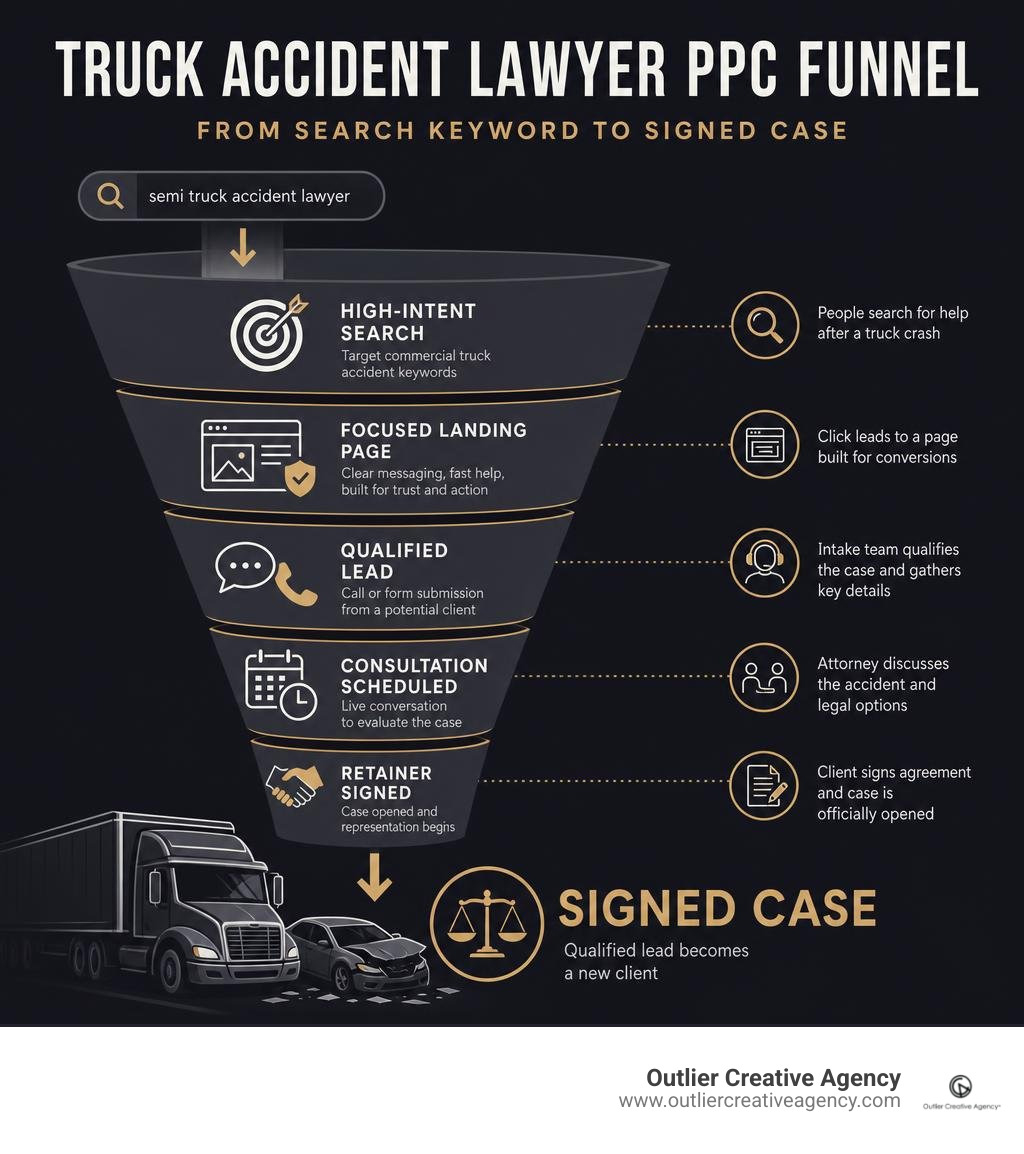
Truck accident lawyer PPC works best when you target high-intent commercial-crash searches, send each click to a focused landing page, and measure signed cases rather than form fills. For law firm owners and marketing directors, the first steps are:
- Bid on terms that signal a commercial truck collision, such as "semi truck accident lawyer" and "18-wheeler accident attorney."
- Exclude irrelevant searches, including CDL jobs, traffic tickets, and property-damage-only claims.
- Lead with fast help and time-sensitive evidence: truck ELD and event-data records can be overwritten in about 30 days without a preservation demand.
- Track calls, qualified leads, consultations, retainers, and cost per signed case in one system.
This specialization matters because commercial trucks can weigh up to 80,000 pounds, claims may involve several liable parties, and interstate carriers generally must carry at least $750,000 in liability coverage, with higher limits for certain hazardous-material loads. A broad car-accident campaign can waste budget; a focused campaign helps your intake team find cases where federal safety rules, commercial insurance, and catastrophic injuries may be central.
I am Corey Larson of Outlier Creative Agency, where we create legal content, websites, video, and lead-generation assets for law firms. Our truck accident lawyer PPC approach focuses on clear positioning, useful conversion paths, and marketing systems built for fast-moving legal intake teams.
1. Why Truck Accident Lawyer PPC Demands a Specialized Legal Marketing Strategy
Running a generic personal injury PPC campaign and hoping for an 18-wheeler case is an expensive gamble. While standard auto collisions involve basic passenger vehicles, a commercial freight collision involves severe physics and layered legal liability. When an 80,000-pound tractor-trailer collides with a standard commuter car, the resulting trauma often leads to complex, catastrophic litigation.
Managing partners and legal marketing directors cannot treat commercial vehicle claims as standard fender benders. Search intent differs entirely. Claimants searching for commercial representation are looking for firms that understand corporate defendants, regulatory violations, and multi-tiered insurance policies.

High Case Values vs. High Cost-Per-Click (CPC) Realities
In legal paid search, commercial vehicle keywords command some of the highest bids across Google Ads. Top-of-page cost-per-click (CPC) rates routinely range between $200 and $450 in competitive metro markets like Los Angeles and Austin.
These premium CPCs exist because the underlying case economics justify the investment:
- Substantial Insurance Policy Limits: Under federal mandates (49 CFR § 387.9), interstate commercial carriers must maintain minimum liability coverage of $750,000 for general freight and up to $5,000,000 for hazardous materials.
- Multi-Layered Coverage: Commercial trucking enterprises frequently carry primary liability, umbrella policies, and excess coverage across multiple corporate entities.
- Significant Settlement Potential: Complex commercial vehicle verdicts and settlements routinely reach seven and eight figures, providing exceptional client lifetime value.
To manage this dynamic successfully, law firms must shift their focus from raw click volume to a disciplined target cost-per-acquisition (CPA). When working with a dedicated law firm PPC agency, law firms structure bidding strategies around the ultimate return on investment of signed retainers rather than vanity traffic metrics.
Leveraging FMCSA Regulatory Violations in Ad Copy and Positioning
Commercial motor carriers are governed by stringent rules enforced by the Federal Motor Carrier Safety Administration (FMCSA). Establishing liability often depends on demonstrating specific regulatory non-compliance, such as:
- Hours-of-Service (HOS) Limits (49 CFR Part 395): Proving driver fatigue or violations of the strict 11-hour driving cap within a 14-hour on-duty window.
- Inspection and Maintenance Records (49 CFR Part 396): Identifying deferred brake maintenance, worn tires, or steering defects.
- Electronic Logging Device (ELD) Tampering: Analyzing digital records for falsified duty statuses.
Incorporating these regulatory realities into your ad copy highlights specialized expertise. Highlighting trial readiness, rapid response investigations, and regulatory enforcement sets your firm apart from general practice attorneys.
When drafting ad copy, legal ethics and state bar advertising rules remain paramount. In both California and Texas, legal advertising must avoid making misleading guarantees, claiming unjustified specialist designations without proper board certifications, or promising specific financial results. Position your firm through authoritative, verifiable facts rather than unsubstantiated claims.
2. Strategic Keyword Architecture and Negative Keyword Filtering for Law Firms
Maximizing the return on your paid advertising budget requires a finely tuned keyword architecture that captures high-value intent while actively deflecting budget-draining searches.
High-Intent Commercial Keywords vs. Low-Value Auto Queries
Your campaign structure should clearly separate standard automotive claims from heavy commercial freight litigation. Group your keywords into distinct ad groups based on intent and commercial vehicle classifications:
- Exact Match Commercial Freight:
[semi truck accident lawyer],[18 wheeler accident attorney],[commercial truck accident law firm] - Specific Vehicle Classifications:
"flatbed truck accident lawyer","dump truck injury attorney","tanker truck collision lawyer" - Corporate Entity Negligence:
"trucking company negligence lawyer","freight carrier injury claim"
By organizing ad groups around specific commercial vehicle terms, you achieve higher Quality Scores, reduce your effective CPC, and deliver hyper-relevant ad messaging directly aligned with the searcher's needs.
Building Robust Negative Keyword Lists to Protect Legal Ad Budgets
Without aggressive negative keyword filtering, commercial vehicle campaigns can easily waste 25% to 40% of their total ad spend on non-revenue searches.
Managing partners must implement exhaustive negative keyword lists that exclude:
- Employment & Licensing Queries:
CDL training,truck driving jobs,how to get CDL,fleet mechanic salary - Administrative & Minor Violations:
truck speed limit ticket,overweight fine,logbook software free download - Property-Only & Minor Damage:
truck bumper repair,windshield replacement commercial,towing rates - Free & Pro Bono Searches:
free legal aid traffic,pro bono truck lawyer,public defender
Applying universal negative keyword lists across every campaign tier protects your budget, ensuring every dollar works toward acquiring catastrophic injury leads. For firms looking to refine their campaign architecture, a comprehensive law firm PPC audit guide 2026 provides an actionable framework to identify and eliminate costly targeting leaks.
3. High-Converting Landing Page Architecture for Personal Injury Law Firms
Capturing a high-value paid search click is only the first half of the equation; your landing page must convert that visitor into an active intake inquiry. Commercial truck landing pages should achieve conversion rates between 12% and 18% when optimized for mobile responsiveness and user trust.
Immediate Proof and Trust Factors: Settlements, Badges, and Accolades
Victims and their families navigating the aftermath of a catastrophic crash need reassurance that your firm has the experience and resources to challenge well-funded corporate defense teams. Essential trust elements include:
- Specific Settlement & Verdict Figures: Display verified, objective case results (e.g., "$4,500,000 Semi-Truck Settlement" or "$2,600,000 Commercial Vehicle Verdict") above the fold.
- Peer Accolades and Industry Honors: Highlight legitimate industry recognition, such as Golden Gavel honors, Super Lawyers, or local trial lawyer association leadership.
- Direct Attorney Accountability: Feature real photography of lead litigation partners rather than generic stock imagery, reinforcing direct communication and authentic advocacy.
To establish early authority, align landing page copy with how jurisdictions handle comparative fault. For instance, in California, claims follow a pure comparative fault doctrine, whereas Texas operates under a modified 51% bar rule. Highlighting how your legal team navigates state-specific comparative negligence reassures prospective clients that partial fault does not automatically preclude financial recovery.
Rapid Intake Integration and Click-to-Call Lead Capture
Timing is critical in commercial freight litigation. Electronic Logging Devices (ELDs) and Event Data Recorders (EDRs, or "black boxes") routinely overwrite digital tracking information within 30 to 90 days unless a formal legal hold is served.
To communicate this urgency and convert high-intent traffic, legal landing pages should incorporate:
- Prominent Click-to-Call Options: Position persistent, direct-dial phone numbers in the top header and sticky bottom navigation on mobile devices.
- 24/7 Live Intake Integration: Provide round-the-clock live chat or immediate screening to assist claimants during evenings and weekends.
- Friction-Free Contact Forms: Limit initial form fields to essential details: Name, Phone Number, Date of Incident, and Brief Summary.
- Fast Lead Follow-Up Protocols: Implement automated SMS and call alerts to ensure your intake department contacts web form submissions within 5 minutes.
Implementing these rapid-response systems allows personal injury firms to secure critical case facts, protect essential evidence, and double their lead-to-case conversion rates.
4. Multi-Layered Targeting and Geo-Fencing Strategies Along Freight Corridors
Commercial trucks move along defined logistics routes. Tailoring your digital advertising around dense industrial hubs and transit corridors maximizes ad exposure where collisions occur most frequently.
Geo-Targeting High-Density Commercial Freight Corridors and Logistics Hubs
Rather than running generic statewide campaigns, personal injury law firms can deploy hyper-targeted radius campaigns around major transit corridors and distribution hubs.
In California, high-risk freight corridors include Interstate 10, Interstate 15, State Route 60, and distribution zones near major shipping facilities like Ontario International Airport, which handled 835,129 tons of cargo in 2025. In Texas, intensive commercial traffic along Interstate 35, Interstate 10, and high-volume freight routes across the Austin-San Antonio corridor represents prime legal marketing geography.
| Targeting Strategy | Typical Conversion Rate | Lead Quality Score | Cost Per Qualified Lead |
|---|---|---|---|
| Statewide Generic PI Campaign | 4.5% – 7.0% | Moderate / Mixed | $450 – $750 |
| Metropolitan Core (Los Angeles / Austin) | 8.0% – 12.0% | Strong | $650 – $1,100 |
| Corridor-Specific (I-10 / I-35 Logistics Hubs) | 12.5% – 18.0% | High (Catastrophic Intent) | $550 – $900 |
Dayparting and Device Optimization for Catastrophic Wreck Inquiries
Over 60% of commercial truck injury searches take place on mobile devices, often shortly after an incident occurs.
- Implement Mobile Bid Adjustments: Increase bid aggressiveness on mobile search placements while utilizing call extensions and mobile call-only ad formats.
- Utilize Strategic Dayparting: Serious commercial freight collisions frequently occur during late-night and early-morning hours when driver fatigue peaks. Ensure your campaigns remain funded during overnight hours, paired with a dedicated 24/7 after-hours intake service.
Targeting drivers and affected families during critical post-accident windows allows your firm to provide immediate support when it matters most.
5. Tracking ROI, Lead Qualification, and Cost Per Signed Truck Accident Case
Sustained growth in paid legal advertising relies on accurate end-to-end performance tracking. Managing partners should measure campaign health by the volume of signed retainers, rather than surface-level click volume.
Calculating True Cost Per Signed Case (CPSC) and Marketing ROI
Measuring true marketing performance requires tracking cases through your practice management software.
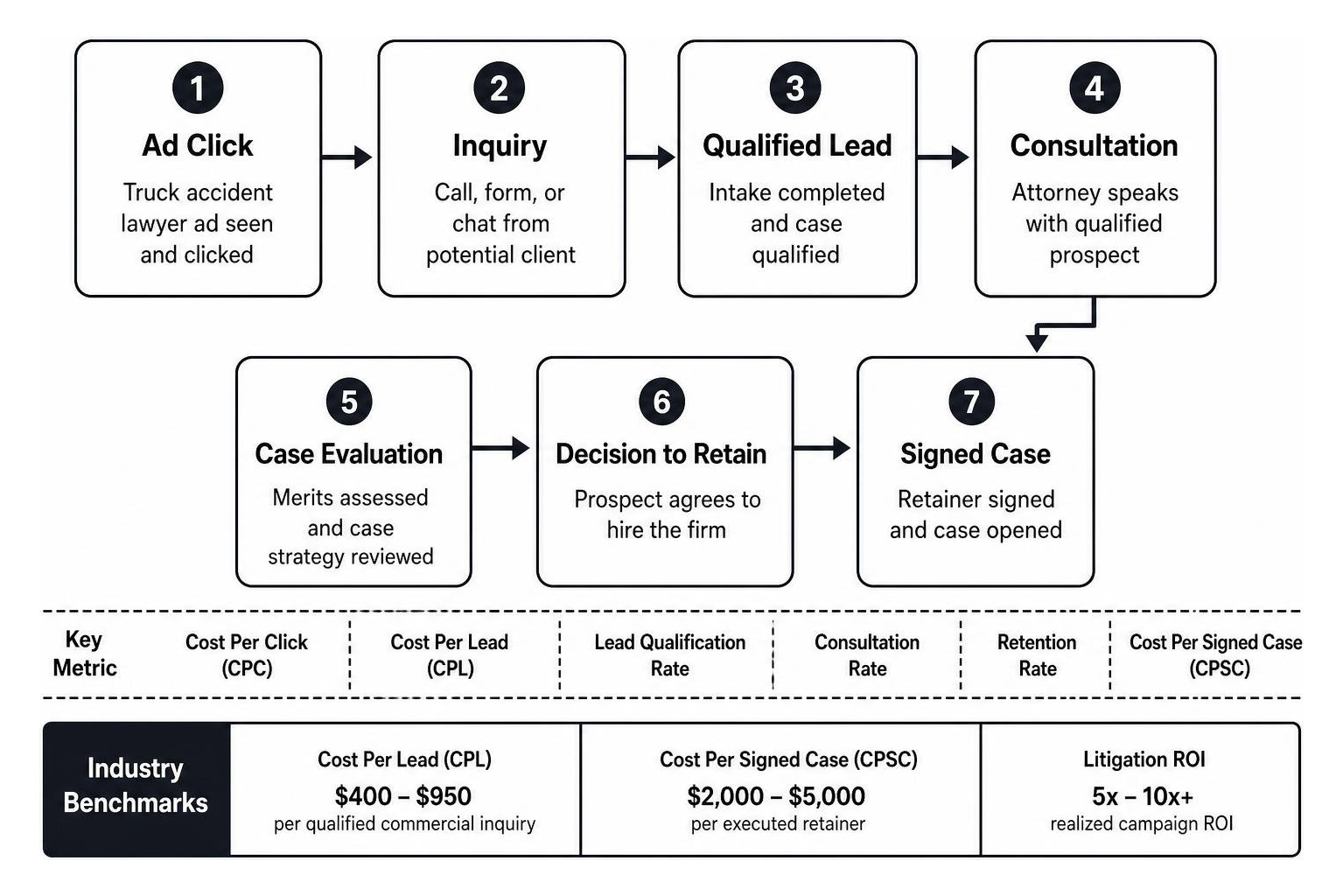
Industry benchmarks for specialized commercial truck campaigns typically reflect:
- Cost Per Lead (CPL): $400 to $950 per qualified commercial inquiry.
- Cost Per Signed Case (CPSC): $2,000 to $5,000 per executed retainer for catastrophic commercial claims.
- Litigation Return on Investment: 5x to 10x+ realized campaign ROI, driven by seven-figure settlement recoveries and significant commercial policy limits.
Firms seeking greater transparency into their performance data can review our law firm PPC analytics guide 2026 to establish end-to-end attribution models across their intake pipelines.
Lead Qualification Protocols for Legal Intake Teams
High-value ad campaigns require trained intake teams prepared to qualify complex claims immediately. Intake specialists should quickly screen for:
- Commercial Status: Confirm the at-fault vehicle was a commercial freight carrier, corporate fleet, delivery van, or heavy tractor-trailer.
- Injury Severity: Document objective physical injuries requiring hospitalization, surgical consultation, or extended therapy.
- Statute of Limitations Constraints: Confirm the incident falls within statutory filing windows—such as the standard two-year limit under California Code of Civil Procedure Section 335.1 or Texas Civil Practice and Remedies Code Section 16.003, while remaining alert to shorter six-month formal notice deadlines for government entities.
- Immediate Evidence Needs: Identify whether rapid spoliation letters are required to preserve black box records, dashcam video, or FMCSA logbooks before the carrier can purge them.
Equipping your intake department with structured qualifying criteria ensures high-intent search leads are swiftly evaluated, retained, and transitioned to your litigation team.
Frequently Asked Questions About Truck Accident Lawyer PPC
What is the average CPC for truck accident lawyer PPC campaigns?
Top-of-page cost-per-click bids for commercial truck accident keywords generally range from $150 to $400+, depending on geographic competition and keyword specificity. While these bids exceed standard automotive terms, the higher rate reflects the significant commercial insurance coverage and substantial settlement values associated with heavy freight litigation.
What is an acceptable cost per signed truck accident case for a personal injury law firm?
A healthy cost per signed case (CPSC) for commercial vehicle litigation typically falls between $2,000 and $5,000. Given that commercial carriers must carry minimum federal coverage of $750,000 to $5,000,000, these acquisition benchmarks routinely generate a strong return on marketing investment.
How can personal injury law firms prevent wasted ad spend on standard car accident searches?
Firms can reduce wasted spend by bidding on exact-match commercial terms (e.g., [18 wheeler accident lawyer]), applying comprehensive negative keyword lists to filter out CDL training and traffic tickets, and explicitly highlighting commercial truck litigation in ad copy.
What conversion rate should law firms expect on specialized truck accident landing pages?
Well-structured, mobile-responsive commercial truck landing pages typically convert between 10% and 18%. Achieving these figures requires clear trust indicators, prominent settlement results, click-to-call functionality, and round-the-clock live intake support.
Conclusion
Building a profitable commercial vehicle docket through paid search requires specialized keyword architecture, mobile-first conversion design, and rigorous intake execution. By aligning your digital campaigns with the technical realities of commercial litigation—from FMCSA safety rules to time-sensitive black box preservation—your practice can consistently sign high-value cases.
At Outlier Creative Agency, we build data-driven marketing systems designed exclusively for personal injury law firms. Explore our comprehensive services for PPC advertising for law firms to scale your commercial truck caseload with confidence and clarity.