
Why San Diego Uber Accident SEO Is One of the Most Competitive — and Lucrative — Legal Keywords in California
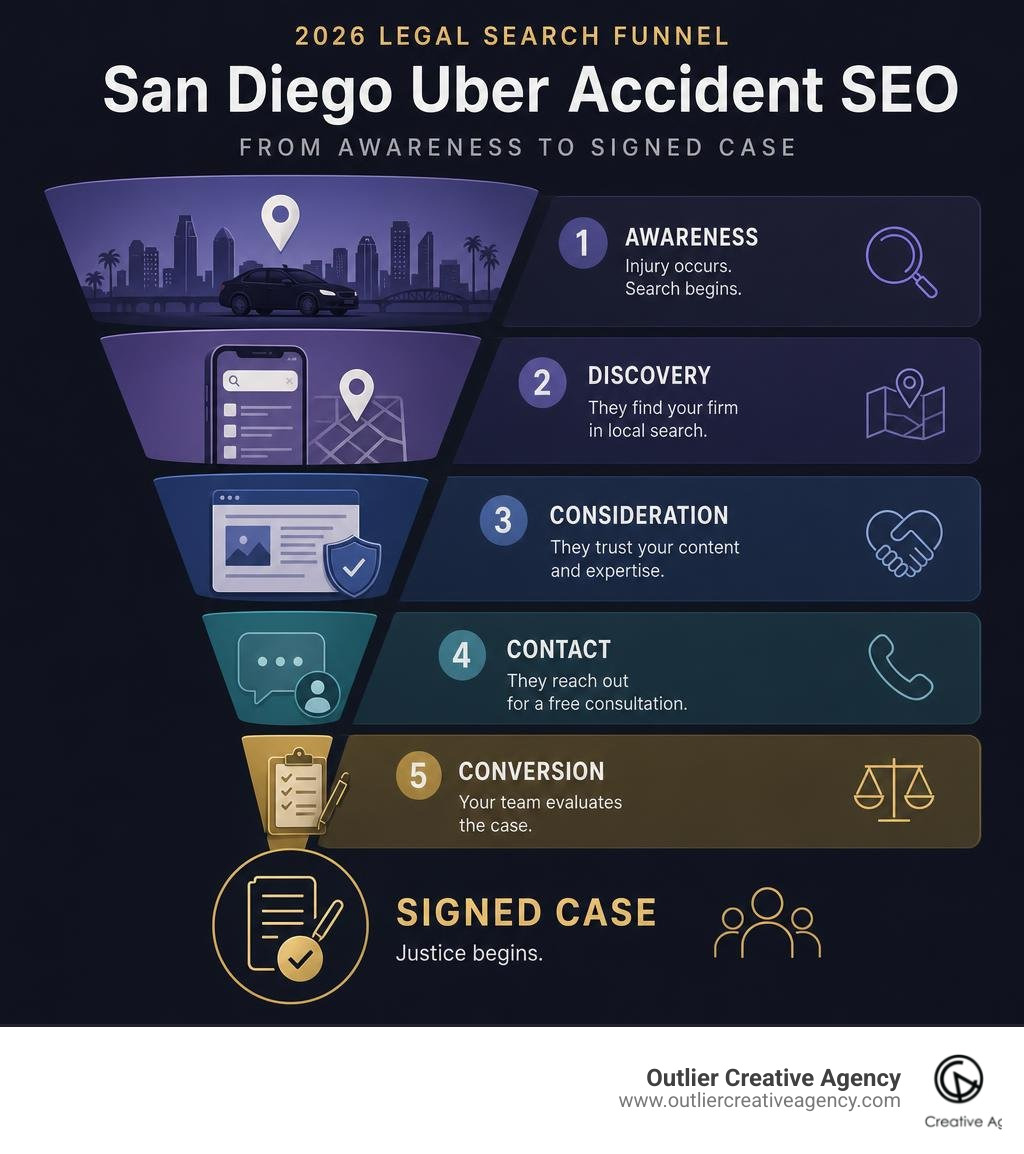
San Diego Uber accident SEO is the practice of optimizing a law firm's website to rank for rideshare injury searches in San Diego County — and in 2026, it's one of the highest-stakes digital marketing plays in California personal injury law.
Here's a quick breakdown of what winning at this looks like:
| Goal | What It Requires |
|---|---|
| Rank in Google's Map Pack | Optimized Google Business Profile + local citations |
| Capture high-intent traffic | Hyper-local landing pages targeting San Diego neighborhoods |
| Convert visitors to clients | Fast mobile experience + clear calls to action |
| Build authority | E-E-A-T content + backlinks from legal and local sources |
| Stay current | Updated content reflecting 2026 California law changes (SB 371) |
San Diego sees over 20,000 car accidents per year — and rideshare vehicles are part of that picture every single day. With more than 75% of personal injury searches happening on mobile devices, and "near me" queries up over 500% since 2015, the firms that show up first in local search are winning cases before a single phone call is made.
The problem? Most personal injury firms treat Uber accident pages like generic car accident pages. They skip the local detail, ignore the insurance complexity, and miss the high-intent long-tail searches that actually convert. That's the gap this guide closes.
I'm Corey Larson, and at Outlier Creative Agency I've worked directly with law firms navigating the intersection of complex legal content and competitive local SEO — including the specific challenges of San Diego Uber accident SEO where rideshare insurance law, California regulations, and hyper-local search intent all collide. If you're a managing partner or legal marketing director trying to grow your rideshare caseload, this guide was built for you.
Why Rideshare Claims Differ from Standard Auto Accidents in Southern California
When a prospective client searches for a rideshare attorney, they aren't just looking for someone who knows how to handle a fender bender. They are looking for a specialist who understands that rideshare claims are fundamentally different from standard auto accidents.
In California, rideshare companies like Uber and Lyft are legally classified as Transportation Network Companies (TNCs). This classification means they are governed by strict regulations established by the California Public Utilities Commission (CPUC).
Unlike a standard car accident where you simply look at the drivers' personal insurance policies, a rideshare accident involves navigating multiple layers of corporate and personal insurance policies. Furthermore, under California's Proposition 22, rideshare drivers are classified as independent contractors rather than employees. This makes direct corporate liability exceptionally difficult to establish unless systemic corporate negligence can be proven.
Because of these complexities, your SEO content must demonstrate deep operational knowledge of these laws. If your practice area pages look identical to your standard car accident pages, both search engines and stressed accident victims will look elsewhere. To build true topical authority and drive high-intent leads, your content must detail how these distinct layers of insurance apply.
For a broader look at how we build high-converting search strategies for firms across California and Texas, check out our More info about SEO services.
| Uber Insurance Phase | App Status | Primary Liability Limit | UM/UIM Coverage Limit (Post-SB 371) |
|---|---|---|---|
| Period 0 | App is closed / offline | Driver's personal insurance | N/A (Personal policy rules apply) |
| Period 1 | App is open; waiting for request | $50,000 per person / $100,000 per accident | State minimums / Contingent |
| Period 2 | En route to pick up passenger | $1,000,000 commercial liability | $300,000 per accident ($60,000/person) |
| Period 3 | Passenger is in the vehicle | $1,000,000 commercial liability | $300,000 per accident ($60,000/person) |
Deciphering Uber’s Three-Tiered Insurance Coverage
To rank for high-intent informational keywords, your website must clearly explain how Uber's insurance limits shift based on the driver's app status at the exact second of the crash.
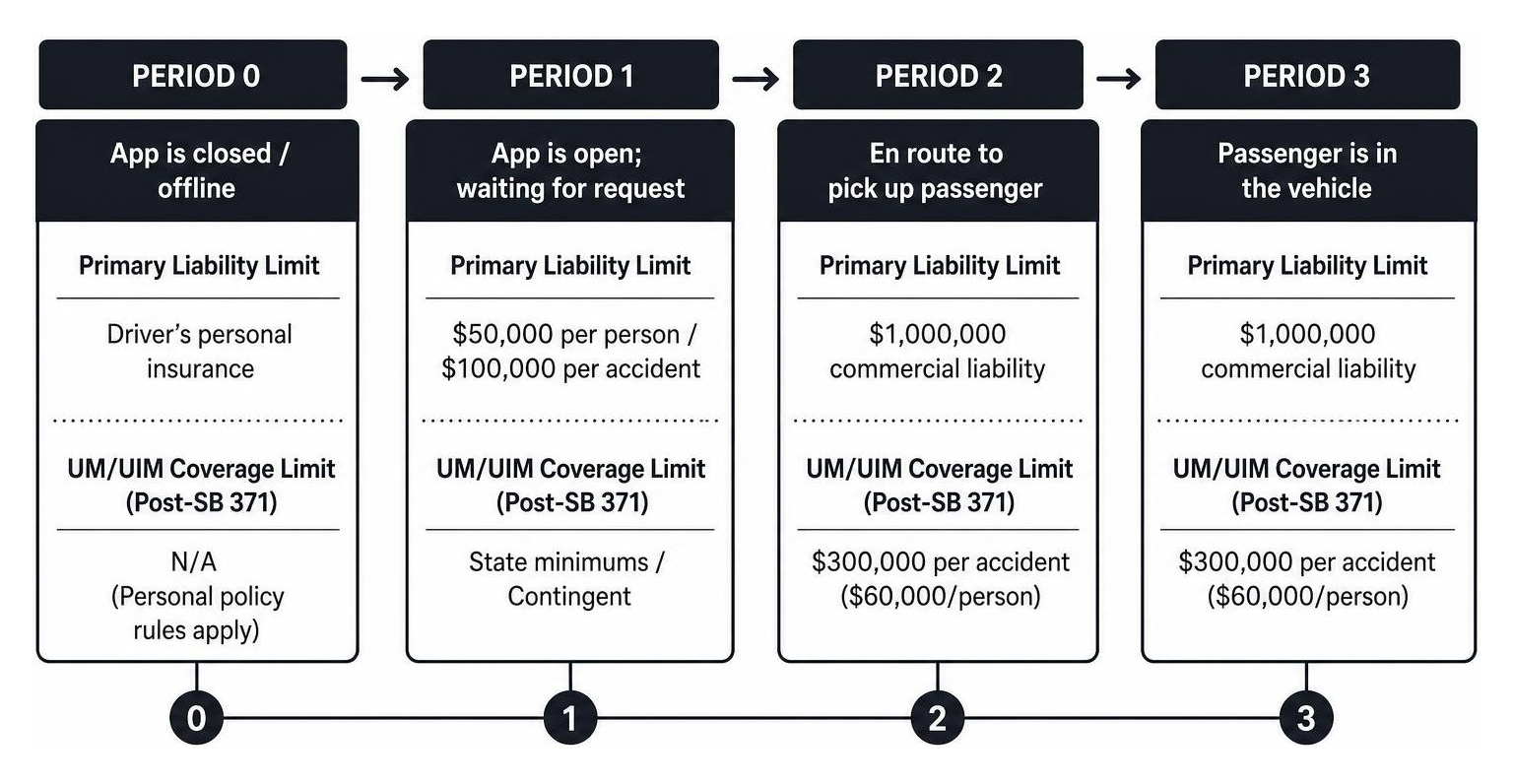
Under CPUC regulations, the available coverage is divided into three distinct periods:
- Period 1 (App On, Waiting for a Match): When a driver is logged into the Uber app but has not yet accepted a ride request, their personal insurance is primary. However, Uber provides contingent liability coverage if the personal carrier denies the claim (which they often do due to commercial use exclusions). This contingent policy covers up to $50,000 per person and $100,000 total for bodily injury, along with $30,000 (recently updated from $25,000) for property damage.
- Period 2 (En Route to Pick Up): The moment a driver accepts a match, Uber’s $1 million commercial liability policy becomes active.
- Period 3 (Transporting a Passenger): This period covers the active trip from passenger entry to exit, backed by the $1 million third-party commercial liability policy.
An essential legislative update for 2026 that your content must address is Senate Bill 371. Effective January 1, 2026, SB 371 reduced the mandatory minimum uninsured/underinsured motorist (UM/UIM) coverage that rideshare companies must carry in California from $1 million down to $300,000 per incident (capped at $60,000 per person). This is a massive shift that directly impacts catastrophic injury claims and represents a major topic gap on most competitor sites.
To explore how these insurance layers dictate a victim's recovery options, see the detailed legal breakdown in Uber Accidents in San Diego: Insurance, Liability, and Your Rights | Phillips & Pelly.
Identifying Liable Parties in Complex Rideshare Crashes
Proving liability in a rideshare crash is rarely straightforward. Depending on the facts of the case, multiple parties can be held liable, including:
- The Uber Driver: If driver distraction, speeding, or fatigue caused the crash.
- Third-Party Motorists: If another driver negligent hit the rideshare vehicle.
- Uber (Corporate Negligence): While Prop 22 protects Uber from standard vicarious liability, the company can still face direct lawsuits for negligent hiring, negligent retention, or failure to act on safety complaints (particularly in rideshare assault cases).
To rank for high-value transactional terms, your content should explain how you overcome the "independent contractor" defense. By demonstrating how your firm subpoenaes app-server data, GPS logs, and telematics to lock down the driver's exact status, you establish your firm as the go-to specialist.
For more insights on structuring multi-defendant rideshare claims, read the comprehensive guide by San Diego Uber Accident Lawyer | J&Y Law.
Dominating the Local Market with San Diego Uber Accident SEO
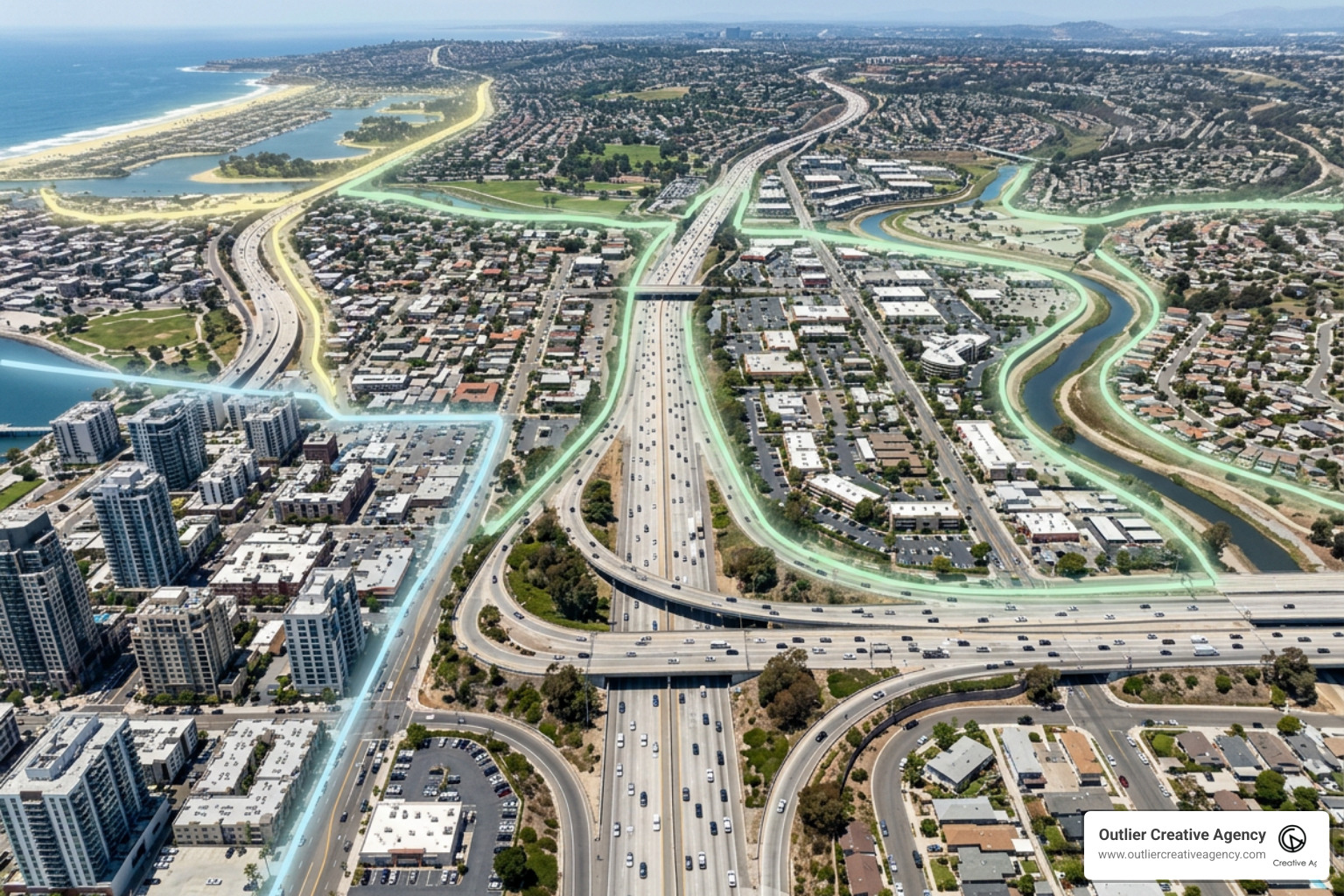
To win at San Diego Uber accident SEO, you must optimize for how local users actually search. Stressed accident victims don't search for abstract legal concepts on desktop computers; more than 75% of personal injury searches happen on mobile devices, and they are looking for immediate, local help.
This makes your Google Map Pack visibility critical. When a user searches for an "Uber accident lawyer near me" from their phone in downtown San Diego, Google relies heavily on proximity, prominence, and local signals to display the top three local firms.
If your digital marketing strategy focuses entirely on broad, national keywords, you are missing the highly localized traffic that actually signs cases. For a closer look at how we run high-performing local campaigns, check out our guide on San Diego Personal Injury Ads.
Why San Diego Uber Accident SEO Requires Hyper-Local Content
One of the biggest mistakes we see personal injury firms make is writing generic "San Diego" content that ignores the actual geography of the city. To rank in a highly competitive metro, you must build pages that target specific high-traffic neighborhoods, transit loops, and local landmarks where rideshare accidents frequently occur.
In San Diego, this means creating content around:
- UC San Diego (UCSD) and University City: High-density student areas with constant rideshare pick-ups and drop-offs near Regents Road, Gilman Drive, and Voigt Drive.
- Westfield UTC: A massive commercial hub with congested rideshare loading zones.
- The Gaslamp Quarter and Downtown: A maze of one-way streets, heavy pedestrian traffic, and late-night rideshare activity near Petco Park.
- San Diego International Airport (SAN): High-speed merges and distracted drivers checking GPS apps.
By mentioning these specific locations, local medical providers (like UC San Diego Health or Scripps Memorial), and regional traffic patterns, you send strong local relevance signals to Google's algorithm.
To see an excellent example of hyper-local targeting in action, read how regional firms approach suburban markets in Uber & Lyft Accident Lawyer in Carlsbad, CA | Rideshare Injury Attorney.
Technical Optimization Tactics for San Diego Uber Accident SEO
High-quality content is only half the battle; your website must also perform flawlessly from a technical standpoint. To ensure search engines can crawl, index, and understand your local rideshare pages, you must implement the following technical tactics:
- LocalBusiness and Attorney Schema Markup: Implement structured data that explicitly tells search engines your exact physical address, phone number, practice areas, and geographic service areas.
- Mobile-First Optimization: Stressed accident victims are searching on mobile devices, often from the scene of the accident or an emergency room. Your pages must load in under two seconds and feature prominent click-to-call buttons.
- Avoid Keyword Cannibalization: Assign exactly one primary keyword to each page. Do not let your "San Diego car accident" page compete with your dedicated San Diego Uber accident SEO page.
For a step-by-step framework on mapping out your site's keyword architecture, explore our resource on Keyword Research Law Firms.
Building High-Converting Content Around the Rideshare Claims Process
To rank in Google's search results and satisfy the search engine's strict Experience, Expertise, Authoritativeness, and Trustworthiness (E-E-A-T) guidelines, your content must be written for real people, not just search algorithms.
Stressed, injured users want clear, empathetic, and actionable answers. If your page is a wall of dry legalese, they will hit the back button, hurting your dwell time and organic rankings. We must design our content to guide the user from the moment of the crash to the resolution of their claim, maintaining ethical compliance at every step.
To learn more about balancing high rankings with State Bar advertising compliance, read our guide on Ethical SEO.
Proving Negligence and Recovering Damages in San Diego Courts
When writing about the claims process, walk your readers through exactly how your firm builds a winning case. Explain that proving negligence in a rideshare accident relies heavily on digital forensics. This includes:
- Subpoenaing App Data: Securing timestamped GPS logs and telematics from Uber to prove the driver’s exact speed, braking patterns, and app phase.
- Preserving Dashcam and Surveillance Footage: Acting quickly to secure video from nearby businesses or campus security cameras before it is overwritten (often a 48-hour window).
- Reconstructing the Scene: Working with local accident reconstruction experts to prove fault in complex San Diego intersections.
Additionally, detail the types of damages your firm helps victims recover, distinguishing between economic damages (medical bills, future rehabilitation, lost wages, and gig-economy income disruptions) and non-economic damages (pain and suffering, emotional distress, and loss of enjoyment of life).
For an authoritative look at proving negligence and maximizing damages under California law, see San Diego Uber Accident Lawyer - Larry H. Parker Accident Attorneys.
Navigating Critical Deadlines and Case Timelines
An excellent way to capture early-stage, high-intent traffic is by answering questions about legal deadlines. Your content should prominently feature California's statute of limitations:
- Personal Injury Claims: Under California Code of Civil Procedure § 335.1, victims generally have two years from the date of the accident to file a lawsuit.
- Government Entity Claims: If the accident involved a government vehicle (like an MTS bus) or was caused by unsafe road design, an administrative claim must be filed within six months under California Government Code § 911.2.
- Property Damage: Victims have three years to file a claim for vehicle damage.
Explain that while a typical settlement negotiation can take two to eight months, complex cases involving catastrophic injuries or disputed liability can take one to two years to resolve in the San Diego County court system.
To help your readers understand these critical legal timelines, reference the step-by-step playbook found in Uber Crash Lawyer San Diego: Post-Accident Legal Guide | Credible Law.
Advanced SEO Strategies: Earning Backlinks and Optimizing for AI Search
As search engines evolve in 2026, traditional keyword optimization is no longer enough. AI-powered search engines like Google's AI Overviews, Perplexity, and ChatGPT are changing how users find legal help.
These AI models synthesize information from highly authoritative, cited sources. To ensure your firm is cited as a trusted authority, you must focus on earning high-quality local backlinks and optimizing for conversational search queries.
For a deep dive into how we build compounding search authority for leading firms, explore our guide on San Francisco Law Firm SEO.
Leveraging Local Digital PR and Data Studies
The single most effective way to build the domain authority required to rank for highly competitive rideshare terms is through local digital PR. Rather than buying low-quality links from spammy directories, your firm should create "linkable assets"—highly valuable, data-driven resources that local journalists, bloggers, and legal publishers want to reference.
Examples of high-value linkable assets include:
- Local Crash Data Studies: Analyzing public UC Berkeley Transportation Injury Mapping System (TIMS) data to identify and map the most dangerous rideshare pick-up zones in San Diego County.
- Rideshare Safety Surveys: Conducting and publishing a localized survey on consumer rideshare safety concerns and experiences in Southern California.
When local news outlets or legal journals link back to your study, your site's overall search authority sky-rockets, lifting your commercial practice area pages along with it.
To see how top-tier local firms leverage authority to dominate the market, review the insights in San Diego Uber Accident Lawyers | Phillips & Pelly.
Optimizing for Conversational and Voice Search Queries
With more than 20% of searches now conducted via voice assistants and AI platforms, your keyword strategy must adapt to natural language patterns. People do not speak in fragmented keywords like "Uber accident lawyer San Diego." Instead, they ask complete questions:
- "Who pays my medical bills if I was hurt in an Uber in San Diego?"
- "Can I sue Uber directly if my driver was negligent?"
- "What is the average settlement for a rideshare passenger in California?"
To target these conversational queries, integrate dedicated FAQ sections on your practice area pages and write comprehensive, question-based blog posts. By using clear, structured headings and answering these questions directly in the first paragraph, you increase your chances of earning featured snippets and being cited in AI search results.
For more actionable strategies on aligning your content with modern user behavior, read our complete guide on Digital Marketing for Attorneys.
Frequently Asked Questions about San Diego Rideshare SEO
How long does it take to rank for competitive San Diego rideshare keywords?
Because the San Diego personal injury market is exceptionally competitive, ranking timelines depend heavily on your website's existing domain authority. For a brand-new domain, expect a timeline of 6 to 12 months of consistent content production, technical optimization, and local backlink building to rank on the first page. However, if you are optimizing an existing site with historical authority, you can often see meaningful traffic increases within 1 to 2 months by targeting long-tail, hyper-local keywords.
What is the 2026 SB 371 insurance change and how does it affect content?
Effective January 1, 2026, California Senate Bill 371 reduced the mandatory minimum uninsured/underinsured motorist (UM/UIM) coverage that rideshare companies must carry from $1 million down to $300,000 per accident (and $60,000 per person). If your website still references the outdated $1 million UM/UIM limit, you are publishing incorrect legal information, which hurts your E-E-A-T signals. You must audit and update all rideshare pages to reflect this 2026 change, positioning your firm as an up-to-date authority.
Do I need separate landing pages for different San Diego neighborhoods?
Generally, yes. Creating dedicated, high-quality landing pages for high-traffic zones like University City (near UCSD), Westfield UTC, and the Gaslamp Quarter allows you to target highly specific long-tail keywords. However, you must ensure that each page features unique, valuable local information—such as specific local intersections, medical centers, and transit loops—to avoid keyword cannibalization and thin content penalties.
Conclusion
Dominating San Diego Uber accident SEO in 2026 requires moving beyond generic car accident content. To capture high-value rideshare cases, your firm must showcase hyper-local geographic knowledge, explain complex California insurance periods, and adapt to modern technical and AI search trends.
At Outlier Creative Agency, we are legal marketing experts with locations in Los Angeles, California and Austin, Texas. We specialize in helping law firms nationwide build authoritative, compliant, and high-converting digital marketing strategies. From SEO and web design to video production and paid search, we deliver the data-driven results that help firms grow their caseloads.
To learn how to balance your organic search efforts with high-performing paid campaigns, explore our comprehensive PPC Marketing Guide for Lawyers.
Ready to stop chasing vanity metrics and start signing more high-value rideshare cases? Let’s build a strategy that works. CTA: Book a Consultation today to speak with our team.