
Why Family Law Firms Can't Afford to Ignore PPC in 2026
PPC for family lawyers is one of the fastest ways to put your firm in front of people who are actively searching for legal help — right now, today, not six months from now.
Here's a quick snapshot of what you need to know:
| What You Want to Know | Quick Answer |
|---|---|
| What is family law PPC? | Paid ads on Google (and other platforms) where you pay per click — not per impression |
| How fast does it work? | Leads can arrive within days of launch |
| What does it cost per lead? | Roughly $70–$150 per lead on average in 2026 |
| What's a good monthly budget? | $3,000–$5,000/month minimum for most markets |
| What's the biggest mistake? | Sending clicks to your homepage instead of a dedicated landing page |
Family law is one of the most emotionally charged practice areas in the legal industry. When someone types "divorce attorney near me" at 10pm on a Sunday, they're not doing casual research — they're in crisis mode. That search intent is exactly why PPC works so well here.
The challenge is that it's also one of the most expensive ad markets in digital marketing. Divorce and custody keywords can run $15–$50 per click in major cities, and a poorly built campaign can burn through budget fast with little to show for it.
Done right, though, the returns are hard to argue with. A single retained divorce client can represent $15,000–$50,000+ in lifetime value to your firm.
I'm Corey Larson, and at Outlier Creative Agency I've worked alongside family law firms to build and manage ppc for family lawyer campaigns that cut wasted spend and drive real signed cases — not just clicks. Let's walk through exactly how to do it.
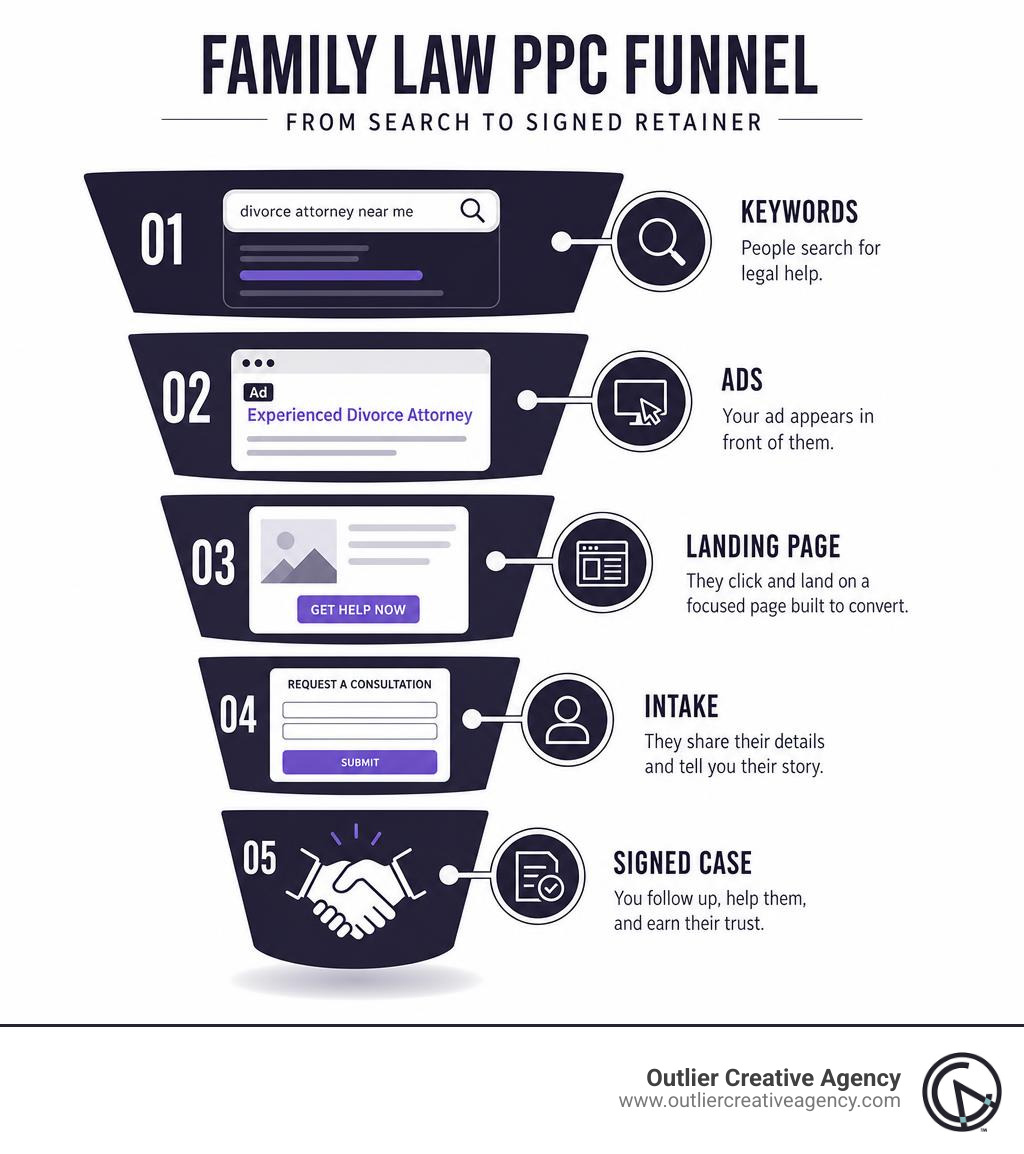
Why is PPC for Family Law Attorneys Essential in 2026?
If you are relying solely on organic search to grow your family law practice in Los Angeles or Austin, you are playing a risky game. Since 2023, zero-click searches have cannibalized approximately 25% of organic lead volume. With search engine results pages (SERPs) heavily prioritizing sponsored results, Local Service Ads (LSAs), and AI-generated summaries, organic listings are being pushed further down the page.
PPC (Pay-Per-Click) advertising bypasses these algorithmic hurdles, granting your firm immediate visibility. Instead of waiting months for search engine optimization to take effect, a well-optimized Google Ads campaign can place your firm at the absolute top of search results within hours of launch. This is a critical competitive advantage in high-stakes markets like Southern California and Central Texas.
Furthermore, family law clients exhibit unique search behaviors. Unlike corporate clients who conduct methodical, weeks-long vendor evaluations, family law prospects often search in moments of extreme emotional urgency. Whether it is a sudden custody dispute or the final straw in a marriage, these prospects are looking for immediate help. PPC allows you to capture these high-intent clients at their exact moment of need.
To understand how paid ads fit into a broader law firm growth plan, check out our comprehensive PPC Marketing Guide for Lawyers. When executed correctly, paid search acts as an immediate pipeline builder while your long-term organic assets mature. For a deeper dive into the mechanics of legal search ads, read our breakdown of PPC Advertising for Law Firms.
How Much Does Family Law PPC Cost? (CPC & CPL Benchmarks)
One of the most common questions we hear is: "How much is this going to cost me?"
The honest answer is that it depends heavily on your geographic market and the specific keywords you target. As of early 2026, the average cost per click (CPC) across Google Ads has experienced a 22% year-over-year surge. While the national average CPC for legal services sits around $17.69, highly competitive metro areas like Los Angeles and Austin frequently see CPCs for premium keywords like "divorce attorney" or "high-net-worth divorce lawyer" range from $40 to over $150 per click.
However, focusing solely on CPC is a vanity metric trap. What actually matters is your Cost Per Lead (CPL) and, ultimately, your Cost Per Signed Case (CPSC). Across the legal industry, the standard CPL for family law PPC hovers around $200. However, highly optimized campaigns utilizing precise negative keyword lists and tailored landing pages can drive CPLs down to $75–$150.
To help you visualize these costs, we have compiled a benchmark table reflecting early 2026 data for competitive metros like Los Angeles and Austin:
| Practice Area / Keyword Group | Average Cost Per Click (CPC) | Target Cost Per Lead (CPL) | Average Matter Value |
|---|---|---|---|
| Contested & High-Asset Divorce | $40 – $120+ | $180 – $340 | $15,000 – $50,000+ |
| Child Custody & Visitation | $25 – $60 | $110 – $220 | $8,000 – $20,000 |
| Child Support & Modifications | $15 – $35 | $80 – $150 | $4,000 – $10,000 |
| Prenuptial & Postnuptial Agreements | $12 – $30 | $70 – $160 | $3,500 – $8,000 |
| Mediation & Collaborative Law | $10 – $25 | $60 – $120 | $5,000 – $12,000 |
To achieve a healthy return on investment, your campaign should aim for a target Return on Ad Spend (ROAS) of $4 to $6 for every dollar invested. If your average retained divorce case generates $10,000 in revenue, a Cost Per Signed Case of $1,500 to $2,500 represents an incredibly profitable and scalable client acquisition system. For more on calculating these margins, explore our guide on The ROI of PPC Advertising for Law Firms: What You Need to Know.
What Are the Best Strategies for Running Family Law PPC Campaigns?

Running a successful family law campaign is not about buying the most clicks; it is about buying the right clicks. To prevent budget leakage and maximize your conversion rates, we implement several advanced campaign management strategies.
Dayparting and Ad Scheduling
Family law search behavior does not follow standard 9-to-5 business hours. In fact, search data reveals distinct spikes in search volume during weekday lunch hours and late evenings (between 7 PM and 10 PM), as well as Sunday mornings. These are times when individuals are away from their spouses and can search privately.
By utilizing dayparting, we can adjust your bidding strategies to raise bids during these high-intent, private search windows. Conversely, we can lower bids or turn off search ads late at night if your intake team is not available to answer live calls. If a lead calls at 2 AM and goes to voicemail, the chance of converting them drops significantly.
Geographic and Radius Targeting
If your office is located in downtown Los Angeles, targeting the entire Southern California region is a fast way to burn your budget. Instead, we use hyper-local geographic targeting. We can target specific high-income zip codes, counties, or a tight radius (e.g., 5 to 15 miles) around your physical offices. This ensures your ads are only shown to prospects who are realistically willing to drive to your office for a consultation.
For Texas firms, managing geographic boundaries is equally critical. To see how to structure these local parameters, consult our Step-by-Step Guide to Running PPC Ads for Your Texas Law Firm.
Audience Sculpting and Negative Keywords
To keep your CPL low, you must actively filter out searchers who cannot afford your services or are looking for free resources. This is where negative keywords are vital. You should immediately exclude terms such as:
- "free", "pro bono", "cheap", "legal aid"
- "forms", "templates", "do it yourself", "pro se"
- "court house", "clerk", "filing office"
If you do not block these terms, you will pay premium CPC rates for searchers who are looking for free legal aid, pro bono services, or local lawyer referral programs. While these are excellent community resources, they are not the target audience for a private firm looking to sign retaining clients.
How Do You Choose the Right Keywords for a Family Law Campaign?
Keyword selection is the foundation of your campaign. If you target broad keywords like "lawyer" or "divorce," you will quickly exhaust your budget on irrelevant traffic. Instead, you must build highly structured ad groups centered around specific keyword match types and user intents.
Google Ads offers three primary match types:
- Broad Match: Matches queries loosely related to your keyword. Avoid this for family law, as it frequently triggers ads for unrelated searches (e.g., bidding on "divorce lawyer" might trigger your ad for "divorce rates in California").
- Phrase Match: Matches queries that include the meaning of your keyword. Designated with quotation marks (e.g.,
"divorce attorney Los Angeles"). This provides a healthy balance of volume and control. - Exact Match: Matches queries with the exact same meaning or intent. Designated with brackets (e.g.,
[child custody lawyer Austin]). This gives you maximum control over your budget.
When building your keyword catalog, segment them by practice area and asset level. For example, do not lump high-net-worth divorce queries in with general divorce searches. High-net-worth individuals use technical, specific search terms like "business valuation divorce attorney" or "asset protection divorce lawyer."
By grouping these high-value keywords into their own ad groups, you can write tailored ad copy that directly speaks to their unique concerns (such as protecting corporate assets or division of complex property). For a step-by-step methodology on keyword research, refer back to our PPC Marketing Guide for Lawyers.
How Should You Structure Your Family Law PPC Budget?
A successful budget structure is built around data, not guesswork. If you are in a highly competitive metro area, starting with a budget that is too low is actually more expensive than starting with an adequate one. Why? Because if your budget only allows for 2 or 3 clicks a day, you will not gather enough statistical data to optimize your campaigns, and your ads will quickly be outbid by larger firms.
For a solo practitioner in Austin or Los Angeles, we recommend a starting monthly ad spend of $3,000 to $5,000. For mid-sized or multi-attorney firms looking to aggressively scale, a monthly budget of $10,000 to $30,000 is typical to dominate the top search positions.
To maximize your budget, you must focus on your Quality Score. Google assigns a Quality Score (from 1 to 10) to your keywords based on three factors:
- Expected Click-Through Rate (CTR): How likely someone is to click your ad.
- Ad Relevance: How closely your ad copy matches the user's search query.
- Landing Page Experience: How helpful, fast, and relevant your landing page is to the user.
A higher Quality Score lowers your actual CPC, meaning you pay less than your competitors for the exact same ad position. By structuring your budget to prioritize Quality Score and optimizing for cost-per-signed-case rather than cost-per-click, you can scale your firm profitably. For budget-conscious practices, our Affordable PPC for Lawyers Guide offers practical tips for maximizing limited ad spend.
Why Are Dedicated Landing Pages Crucial for Family Law Conversions?
Sending your paid PPC traffic to your law firm's homepage is the single most expensive mistake you can make. A homepage is designed to be informational and multi-purpose. It contains links to your bio, your blog, various practice areas, and community involvement. For a crisis-driven family law prospect, this presents too many distractions, leading to high bounce rates.
Instead, every ad campaign must direct traffic to a dedicated, highly optimized landing page tailored to the specific search query. If someone clicks an ad for "child custody attorney," they should land on a page exclusively about child custody — not a generic page that also discusses prenuptial agreements and property division.
An elite family law landing page should convert at 10% to 15% (compared to the industry average homepage conversion rate of 3% to 5%). To achieve this, your landing pages must include:
- Frictionless Contact Options: Place click-to-call buttons and short, confidential contact forms above the fold. Over 70% of family law searches occur on mobile devices, so your page must load in under 3 seconds and be fully optimized for mobile users.
- Trust and E-E-A-T Indicators: Include professional photos of your attorneys, badges of your legal associations, and verified client testimonials emphasizing your compassion and professionalism.
- Clear Value Proposition: Address the user's emotional state immediately. For example, instead of a generic headline like "Experienced Austin Family Law Firm," use empathetic, benefit-driven headlines like "Protecting Your Children and Your Assets during Divorce."
It is also important to understand the self-help landscape in your market. For example, many users search for DIY resources like Limited Scope and Self-Help “Pro Se” Forms - Mary Jones Austin ... . Your landing page copy should clearly explain why hiring a full-representation attorney is critical to protecting their parental rights and financial future, effectively turning research-mode searchers into retained clients.
For a complete blueprint on building high-converting, compliant landing pages, read The Ultimate Guide to PPC for Law Firms: Compliance-Safe Ads That Actually Bring Clients.
How Do You Navigate Ethics and Bar Rules in Family Law Advertising?
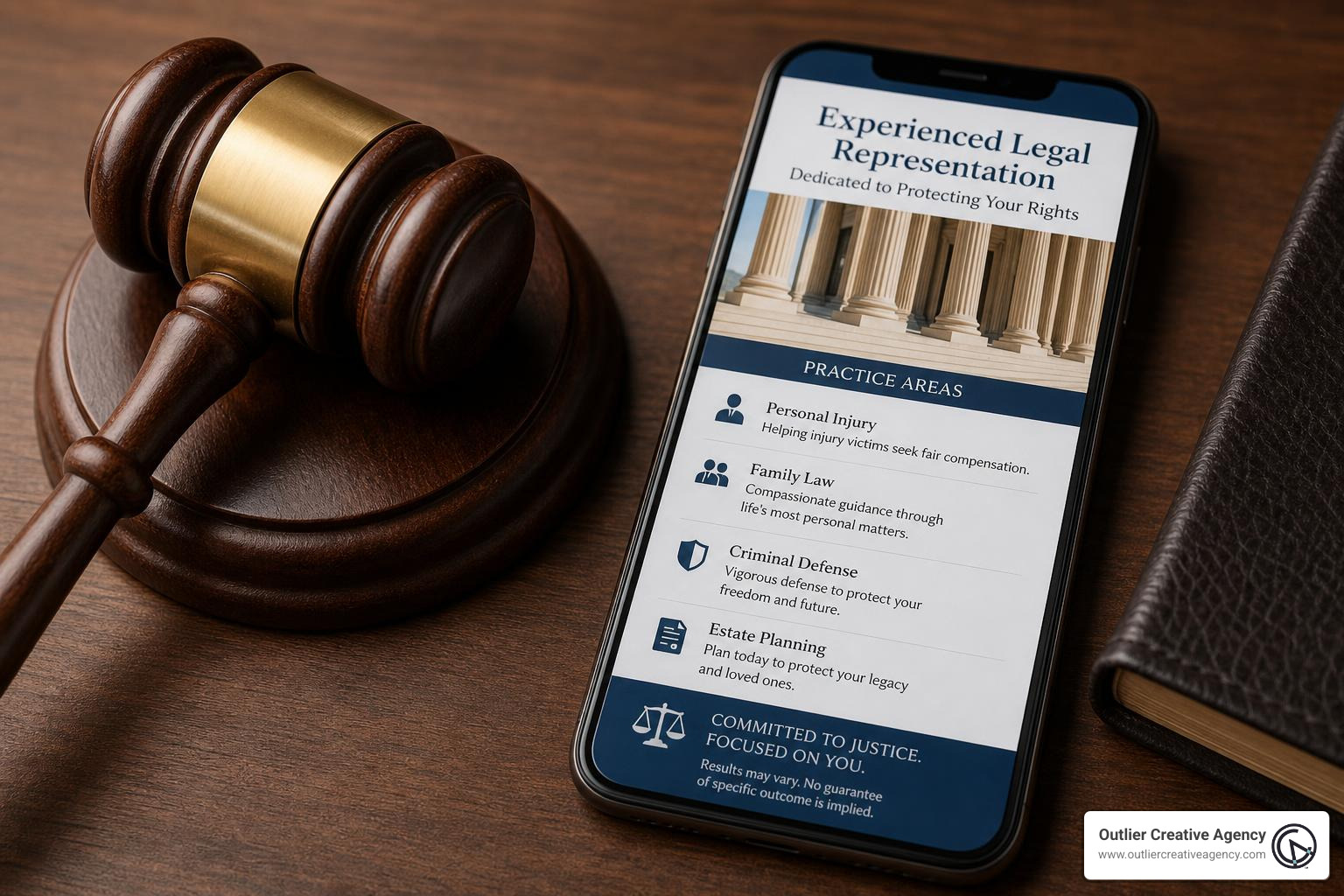
Legal advertising is subject to strict ethical oversight, and family law is no exception. When running PPC campaigns in California or Texas, your ad copy and landing pages must comply with local State Bar rules.
In California, you must adhere to the California Rules of Professional Conduct (specifically Rule 7.1 through 7.5) and relevant statutory guidelines like California SB 37, which govern public disclosures and attorney advertising. In Texas, the Texas Disciplinary Rules of Professional Conduct outline strict guidelines regarding misleading statements, disclaimers, and claims of specialization.
Key compliance rules to keep in mind include:
- No Guaranteed Outcomes: You can never state or imply a guaranteed result. Avoid phrases like "We will win your custody battle" or "Guaranteed asset protection." Instead, use descriptive language like "Dedicated to protecting your parental rights."
- Clear Disclaimers: Your landing pages must include visible disclaimers stating that the information provided is not formal legal advice and does not establish an attorney-client relationship.
- Google's Sensitive Life-Event Policy: Google strictly prohibits personalized advertising (remarketing/retargeting) for sensitive categories, which includes divorce, marital disputes, and family crises. This means you cannot run standard retargeting campaigns to follow a user around the internet with ads after they have visited your divorce page. Because you only get one chance to capture their contact information, your landing page design must be incredibly persuasive on their first visit.
Furthermore, local administrative procedures can impact how you position your services. For example, in Southern California, understanding local court resources, such as the role of [PDF] Parenting Plan Coordinators—Los Angeles County Family Law ... , is essential. Your ad copy and educational landing page content should accurately reflect these local legal frameworks without misleading the public.
To ensure your campaigns remain fully compliant while still driving high conversion rates, refer to our guide on Lawyer Google Advertising in 2025: Bar Rules, Smart Campaigns, and ROI Tips.
How Do You Integrate PPC with SEO for a Blended Search Strategy?
While PPC is an incredible tool for generating immediate leads, it should not operate in a vacuum. The most successful family law practices utilize a blended search strategy that integrates paid search with Search Engine Optimization (SEO) and Local Service Ads (LSAs).
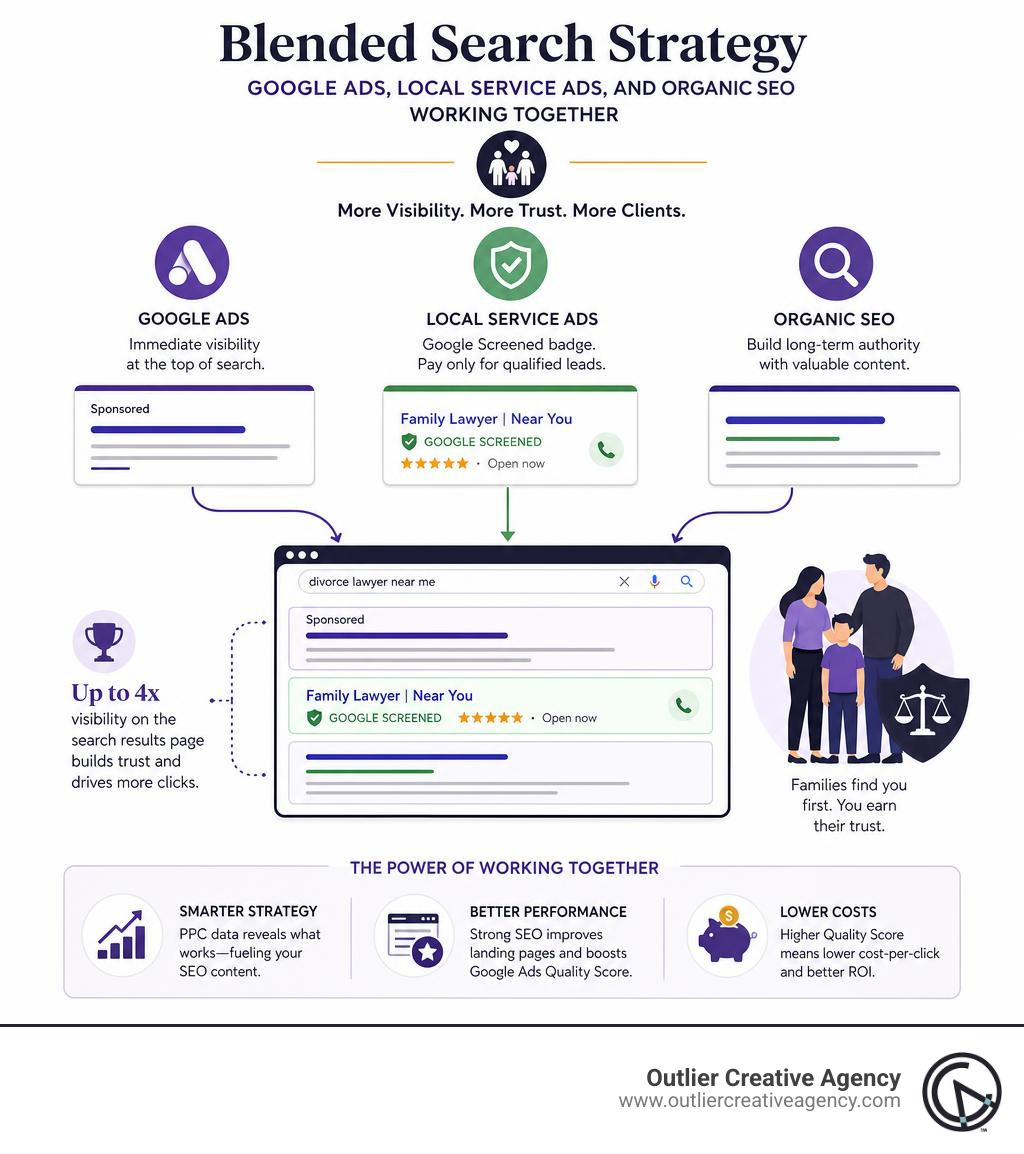
When you run PPC and SEO together, you create a compounding ROI effect:
- SERP Domination: By bidding on Google Ads, participating in LSAs (which display the "Google Screened" badge and charge per lead rather than per click), and ranking organically, your firm can appear up to four times on a single search results page. This builds massive brand authority and trust.
- Keyword Intelligence Sharing: PPC provides immediate data on which exact search terms result in signed cases. You can then feed these high-converting keywords directly into your SEO content strategy, saving you months of trial-and-error content creation.
- Quality Score Synergy: A highly optimized, content-rich website built for SEO naturally provides a superior landing page experience. This improves your Google Ads Quality Score, which in turn lowers your cost-per-click.
By balancing your marketing budget between immediate paid lead generation and long-term organic equity, you build a resilient, sustainable client acquisition system. For an in-depth analysis of how to allocate your budget between these two channels based on your firm's growth stage, read our guide on SEO vs. PPC for Law Firms in 2026: ROI, When to Use Each, and How to Integrate Them.
Frequently Asked Questions about Family Law PPC
Why do most family law Google Ads campaigns fail?
Most family law campaigns fail due to three primary mistakes:
- Using Broad Match Keywords: Bidding on broad terms like "divorce" or "custody" without match type constraints triggers ads for irrelevant, low-intent searches, wasting your budget on non-qualified clicks.
- Sending Traffic to the Homepage: Clicks are sent to a generic homepage rather than a tailored, high-converting landing page, leading to high bounce rates.
- Weak Intake Processes: If your intake team does not answer calls live, follow up with form submissions within 15 minutes, or handle sensitive inquiries with empathy, your paid leads will simply call the next firm on the list.
What is a realistic monthly budget for family law PPC?
In competitive metropolitan areas like Los Angeles and Austin, a starting monthly ad spend of $3,000 to $5,000 is recommended for solo practices to secure a meaningful share of the market. For mid-sized firms looking to scale multiple attorneys, budgets typically range from $10,000 to $30,000+ per month, depending on the volume of cases desired.
How do you track a Google Ads click to a signed case?
To measure your true ROI, you must track the entire client journey from click to signed retainer. We achieve this by:
- Call Tracking: Implementing dynamic number insertion (DNI) to track which exact keyword and ad triggered a phone call.
- GCLID Capture: Capturing the Google Click Identifier (GCLID) when a user submits a contact form.
- CRM Integration: Linking your call and form tracking tools with your law firm's CRM (such as Clio or Filevine). When a lead signs a retainer, this conversion data is pushed back into Google Ads, allowing the algorithm to optimize for signed cases rather than just clicks.
Conclusion
Managing ppc for family lawyer campaigns does not have to be a source of drama for your firm. When built on a foundation of precise keyword targeting, disciplined negative keyword management, high-converting dedicated landing pages, and strict compliance with State Bar rules, Google Ads can become your practice's most predictable and profitable source of new cases.
At Outlier Creative Agency, we specialize in building data-driven, compliance-safe digital marketing systems designed exclusively for law firms. We handle the technical complexities, the bid management, and the conversion optimization so you can focus on what you do best: advocating for your clients.
If you are ready to stop guessing and start scaling your family law practice in Los Angeles or Austin, we are here to help. Explore our specialized services for PPC Advertising for Law Firms and book a consultation with our team today to build your custom growth blueprint.