
Why Most Law Firms Are Losing Clients Without Motion Graphics Legal Videos
Quick Answer: What Are Motion Graphics Legal Videos?
| Type | Best Used For |
|---|---|
| 2D Explainer Videos | Client education, legal tech demos, social media |
| 3D Forensic Animations | Courtroom evidence, accident reconstruction, medical malpractice |
| Kinetic Typography | Brand videos, law firm marketing, YouTube ads |
| Animated Timelines | Case chronologies, commercial disputes, trial presentations |
| Infographic Videos | Practice area overviews, FAQ content, social media engagement |
Motion graphics legal videos are animated visual content built specifically for law firms, courtrooms, and legal tech platforms — and they are quickly becoming one of the most powerful tools in legal marketing and litigation strategy.
The legal industry has been slow to adopt video. According to the American Bar Association, only about 24% of law firms currently use video for marketing. That gap is a massive opportunity for firms willing to move first.
And the stakes are real. A Gallup poll found that only 3% of people rate lawyers' honesty as "very high." Video — done right — is one of the few formats that can actually close that trust gap before a potential client ever picks up the phone.
On the litigation side, the impact is even more direct. Visual evidence helps jurors process and retain complex facts. Cases backed by strong visual strategy have reached verdicts in the hundreds of millions of dollars.
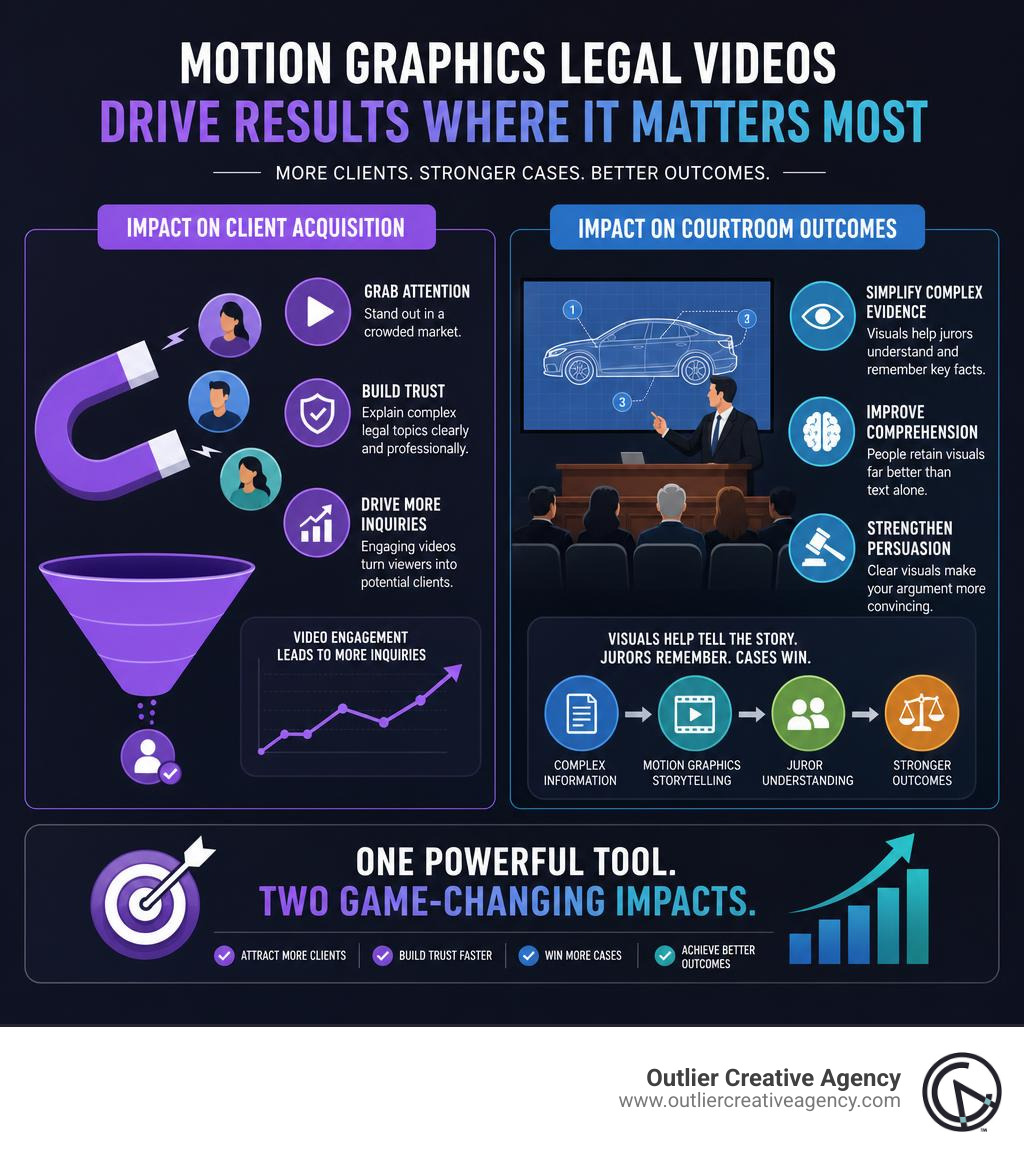
Whether you're trying to win more clients online or win more cases in the courtroom, motion graphics give you an edge that static content simply cannot match.
I'm Corey Larson, and at Outlier Creative Agency I've spent years producing motion graphics legal videos for law firms and legal professionals who need content that is accurate, compelling, and built to perform. In the sections below, I'll walk you through exactly what these videos are, how they work, and how to use them to grow your firm and strengthen your cases.
What Are Motion Graphics Legal Videos and How Do They Work?
At its core, a motion graphics legal video is the strategic combination of graphic design, animation, and legal storytelling. Unlike traditional live-action videography—which relies on cameras, physical sets, and on-screen talent—motion graphics use digital assets to explain abstract concepts, reconstruct physical events, or guide an audience through complex data.
In our work at Outlier Creative Agency, we see motion graphics as a spectrum of digital techniques. This spectrum ranges from clean, simplified 2D vector animations used in corporate legal tech demos to highly technical 3D modeling and forensic reconstructions designed for the courtroom.
Behind every high-performing legal animation is a disciplined multi-step process:
- Scripting and Legal Alignment: Translating dense legal briefs, expert witness reports, or medical records into a clear, narrative-driven script.
- Storyboarding: Creating a frame-by-frame visual blueprint to map out how the graphics will flow alongside the narrative voiceover.
- Asset Design: Developing custom 2D illustrations, kinetic typography, or 3D models of environments, machinery, or human anatomy.
- Animation and Sound Design: Bringing the static elements to life with fluid motion, professional voiceovers, and subtle sound effects to emphasize key moments.
By utilizing these steps, law firms and legal tech platforms can transform unstructured, overwhelming data into a digestible visual narrative that anyone can understand.
Why Motion Graphics Legal Videos Outperform Static Trial Exhibits
The human brain is hardwired for visual processing. In fact, scientific research indicates that the brain processes visual stimuli thousands of times faster than plain text. When a jury or a prospective client is presented with a mountain of text-heavy documents, they experience cognitive overload. Their brains work harder to decode the letters, leaving less mental energy to actually analyze and retain the information.
Static trial exhibits, such as printed foam boards or basic PDF slide decks, are a step up from raw text, but they still fall short in representing time, motion, and perspective. Motion graphics solve this by aligning information with the natural way humans learn:
- Temporal Clarity: Animated timelines allow viewers to see the chronological sequence of events unfold in real time.
- Spatial Understanding: 3D legal animation allows an audience to fly through an accident scene, viewing it from multiple angles, which is impossible with a flat, static photograph.
- Focus Control: By using kinetic typography and dynamic highlights, you control exactly where the viewer's eyes go, ensuring they do not miss critical details.
For firms looking to see how these techniques translate to real-world applications, exploring professional portfolios is highly recommended. You can view dynamic visual examples through the Samples – Explore Real Legal Videos, Animations & Graphics portfolio, which illustrates the stark difference between flat boards and moving evidence.
The Power of Motion Graphics Legal Videos in Modern Litigation
In high-stakes litigation, clarity is the ultimate currency. When presenting a case to a judge, jury, or mediator, the legal team that tells the clearest, most memorable story usually wins. This is why top-tier litigators rely heavily on forensic animation and accident reconstruction to make their arguments undeniable.
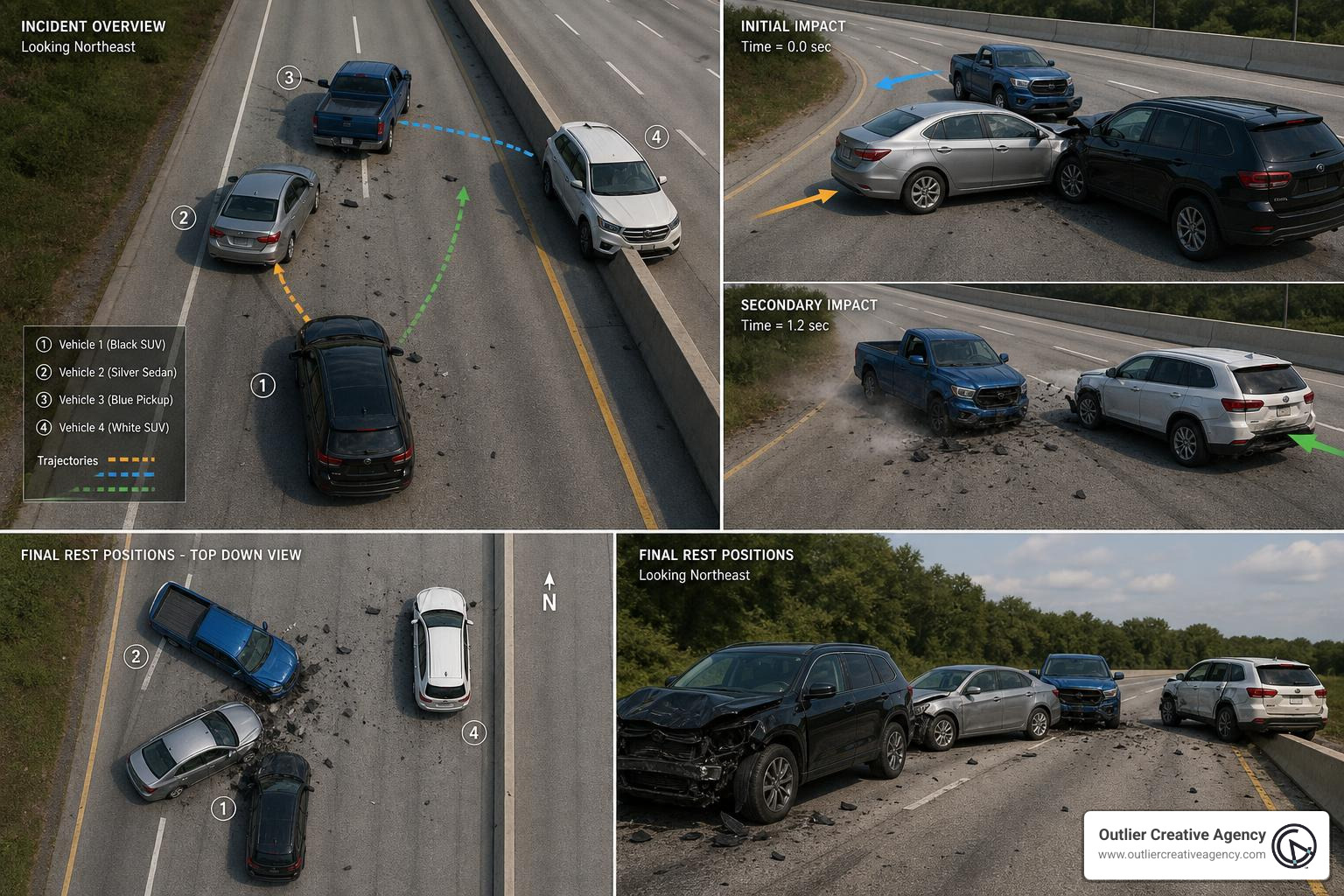
Consider a complex medical malpractice case or a multi-vehicle commercial collision. Telling a jury about a "priapism caused by a triple-drug injection overdose" or explaining "coefficient of friction and momentum transfer" using only verbal testimony is a recipe for confusion.
However, when you present a 3D medical animation showing the precise biological mechanism of injury, or a forensic reconstruction showing the exact speeds and lane changes of a commercial truck, the abstract becomes concrete.
Using high-end visuals signals to the opposing counsel that your firm is prepared, professional, and ready to take the case to a verdict. To understand how high-quality video production can reshape your firm's entire market position, read our guide on How Video Marketing Elevates Law Firm Branding.
Admissibility Standards for Courtroom Animations
While courtroom animations are incredibly persuasive, they must pass strict legal hurdles before they can ever be shown to a jury. In the United States, including key jurisdictions like Los Angeles, California, and Austin, Texas, the admissibility of demonstrative evidence is governed by specific rules.
To ensure your motion graphics are admitted into evidence, they must meet the standards outlined in the Federal Rules of Evidence (FRE) or their state-level equivalents:
- FRE 401 (Relevance): The animation must have a direct tendency to make a fact of consequence more or less probable than it would be without the visual.
- FRE 403 (Prejudice vs. Probative Value): The visual must not be overly sensational, gruesome, or designed solely to trigger an emotional response. Its probative value must outweigh any potential unfair prejudice.
- FRE 901 (Authentication): You must prove that the animation is a fair and accurate representation of the facts. This is typically done through the testimony of a qualifying expert witness (e.g., an accident reconstructionist or treating physician) who can vouch that the animation accurately reflects their calculations and opinions.
[ADMISSIBILITY CHECKLIST UNDER FRE 901]
[ ] Built directly from official records (police reports, laser scans, medical imaging).
[ ] All assumptions and data gaps are clearly labeled and documented.
[ ] Expert witness has reviewed and approved every frame of the animation.
[ ] Source control and version tracking are maintained throughout production.
[ ] The animation illustrates expert testimony rather than attempting to act as independent proof.
Working with experienced professionals who understand these strict evidentiary standards is non-negotiable. For specialized support, firms in California often turn to Legal Videography Services | Best Evidence Video | Los Angeles to ensure their visual evidence is properly formatted and legally sound.
Key Types of Motion Graphics for Law Firms and Legal Tech
Not all legal videos serve the same purpose. Depending on whether you are presenting in a courtroom, pitching a legal tech platform, or running a digital marketing campaign, you will need a specific visual format.
| Animation Style | Production Complexity | Primary Legal Application |
|---|---|---|
| 2D Motion Graphics | Moderate | Explainer videos, social media ads, brand storytelling, legal tech demos |
| 3D Forensic Animation | High | Courtroom accident reconstruction, medical malpractice, product liability |
| Kinetic Typography | Low to Moderate | Website homepages, digital ads, complex policy explainers |
| Interactive Timelines | Moderate | Mediation packages, commercial litigation, patent disputes |
Choosing the right format is critical to matching your brand's tone and your case's goals. Whether you are looking to build authority online or explain a sophisticated practice area, investing in professional Media Production for Law Firms ensures your visual assets look polished and perform flawlessly.
Explainer Videos for Legal Tech and Complex Litigation
The legal tech industry is booming, but many software platforms struggle to explain how their tools work. When you are dealing with AI-assisted document review, contract lifecycle management, or automated eDiscovery, trying to explain these processes in written copy can cause potential buyers' eyes to glaze over.
A 2D motion graphics explainer video can distill these complex systems into a clear, engaging story. For example, when global law firm DLA Piper launched its AI-driven compliance tool, Aiscension, they collaborated with media professionals to create a brief, high-impact animated explainer. The video effectively demonstrated how the tool could quickly scan over 150,000 documents across 100+ languages to detect bribery risks. You can view the details of this visual campaign at the Aiscension Promo | Janno Media case study.
Similarly, legal tech platforms like Goodfact use structured motion graphics to show how they turn massive, unstructured "document dumps" into clean, defensible chronologies. To see an example of an enterprise-ready narrative designed for legal tech, take a look at the Motion Graphics Explainer Video for LegalTech Platform :: Behance showcase.
Interactive Timelines and Case Chronologies
In commercial litigation, breach of contract cases, or construction disputes, the core of the argument often comes down to timing. Who knew what, and when did they know it?
Instead of forcing a judge or jury to flip through hundreds of pages of printed emails, call logs, and bank statements, an animated timeline brings the chronology to life. By combining call logs, text messages, and payment activity into a single, cohesive motion graphic, you make the sequence of events immediately obvious.
For firms looking to implement these visual strategies in Austin, Texas, working with local creative teams like Video & Photo Content for Law Firms | Austin, Texas - Bennett Creative or Motion Graphics Video Production in Austin, TX - Swng Productions can help you build custom, high-impact timelines that keep your audience oriented.
Maximizing ROI: Motion Graphics in Legal Marketing and Client Acquisition
While courtroom animations win cases, marketing-focused motion graphics win clients. Prospective clients are looking for quick, clear answers to their legal problems.
By utilizing animated FAQ videos, practice area overviews, and social media ads, you can dramatically increase your online visibility and lead conversion rates. Because video content is highly shareable, it is also a powerful tool for driving traffic from YouTube, Facebook, and Google My Business. To learn how to build a comprehensive digital video strategy, check out our guide on how to Boost Law Firm Visibility: 7 Proven Video Marketing Strategies for More Leads & Clients.
Best Practices for Producing Compliant Motion Graphics Legal Videos
When using motion graphics for public-facing marketing, law firms must navigate a minefield of state bar association advertising rules. What works for a traditional consumer brand could easily violate legal ethics rules regarding client solicitation and misleading claims.
To keep your marketing campaign compliant and effective, follow these core best practices:
- Avoid Guaranteeing Outcomes: Never use animations to imply a guaranteed win or specific settlement amount. Keep the focus on your firm's process, dedication, and experience.
- Balance Emotion and Authority: While it is important to validate a client's frustration (such as their struggle with an insurance company's lowball offers), you must ground that emotion with professional authority. Too much emotion without authority looks cheap; too much authority without emotion feels cold.
- Include Prominent Disclaimers: Ensure that any video containing dramatizations, stock graphics, or generalized legal information includes clear, legible disclaimers that comply with your local bar guidelines.
For a deeper dive into crafting high-converting, compliant video ads that drive actual cases to your firm, read our breakdown of Caseload Boosting Video Ads.
Measuring the Business Impact and Case Value ROI
Investing in high-end video production is not just a branding exercise—it is a business decision with measurable returns.
For marketing campaigns, law firms can track key performance indicators (KPIs) such as:
- Click-Through Rate (CTR): Video ads consistently outperform static image ads, often driving a significantly lower Cost Per Acquisition (CPA).
- On-Page Dwell Time: Adding a motion graphics video to your homepage or key landing pages keeps visitors on your site longer, which signals to search engines that your content is valuable, boosting your SEO.
For litigation, the ROI is even more dramatic. Attorneys who integrate professional animations into their mediation packages and trial presentations routinely see a 2x to 10x increase in their average case values. High-quality visuals put pressure on insurance defense teams, often forcing them to settle for much higher amounts to avoid facing a highly prepared plaintiff's counsel in front of a jury.
To explore how high-end production elevates your firm's bottom line and establishes market authority, read The Visual Verdict: Elevating Law Firm Digital Marketing with High-End Production.
Frequently Asked Questions About Legal Motion Graphics
How much do legal motion graphics videos cost to produce?
The cost of producing a motion graphics legal video varies widely based on complexity, style, and length. A standard 2D animated explainer or brand video can range from $1,200 to $15,000. Highly complex, scientifically accurate 3D forensic animations or medical reconstructions for courtroom use require specialized software, expert collaboration, and rigorous verification, which typically ranges from $15,000 to $50,000+ per project.
How long does the production process take for courtroom animations?
A typical courtroom animation takes anywhere from 4 to 12 weeks to complete. The timeline depends heavily on the speed of gathering foundational data (police reports, medical scans, expert witness opinions), the complexity of the modeling, and the number of revision rounds required to ensure absolute scientific and legal accuracy before trial deadlines.
Can motion graphics be used in mediation and settlement packages?
Yes. In fact, using motion graphics during the mediation phase is one of the most effective strategies for securing favorable settlements without the expense of a full trial. Presenting a polished, animated reconstruction or medical mechanism video during mediation shows the defense exactly how prepared you are and makes the physical reality of your client's injuries impossible to ignore.
Conclusion
In a legal landscape where attention spans are shrinking and competition is fiercer than ever, standing still is not an option. Whether you are trying to simplify complex legal concepts for a jury, explain a cutting-edge legal tech platform, or build trust with prospective clients online, motion graphics legal videos are your most powerful tool to cut through the noise.
At Outlier Creative Agency, we specialize in helping law firms nationwide build authoritative, compliant, and highly persuasive visual campaigns. From our offices in Los Angeles, California, and Austin, Texas, we deliver end-to-end video production, digital marketing, and SEO strategies tailored specifically for the legal industry.
Don't let your firm's message get lost in a sea of static text. Partner with Outlier Creative Agency for Professional Legal Video Production and let us help you turn complex arguments into winning visual stories. Contact us today to schedule your custom video consultation.