
Why Keyword Research for Law Firms Determines Who Gets the Case
Keyword research for law firms is the single most important step in any legal SEO strategy — and most firms skip it entirely.
Here's a quick answer if you need it fast:
How to do keyword research for law firms:
- Define your practice areas — list every service you actually offer
- Build seed keywords — combine practice area terms with location modifiers (e.g., "divorce attorney Houston")
- Research intent — separate informational queries from high-intent, ready-to-hire searches
- Evaluate keywords — check search volume, keyword difficulty, and estimated case value
- Target long-tail terms — phrases like "workers comp lawyer free consultation Chicago" convert better than "lawyer near me"
- Map keywords to pages — one primary keyword per page, no overlap
Think about this: 96% of people seeking legal advice use a search engine at some point. Yet most law firm websites are built around what attorneys think clients search for — not what clients actually type into Google.
That gap is expensive.
A firm ranking for "how long does a bruise take to heal" gets traffic. It signs zero cases. Meanwhile, a competitor ranking for "car accident attorney near me" gets fewer visitors — but a full consultation calendar.
The difference isn't luck. It's keyword strategy.
When your site aligns with the exact phrases real clients use at the exact moment they're ready to hire, organic search becomes your most reliable source of new business. And the numbers back that up — firms investing in SEO report 40% lower client acquisition costs compared to PPC-only strategies over a 24-month period.
I'm Corey Larson, and at Outlier Creative Agency I've spent years helping law firms cut through the noise with keyword research for law firms that drives actual consultations — not just clicks. If you're a managing partner or legal marketing director tired of watching competitors show up first in search results, this guide is built for you.
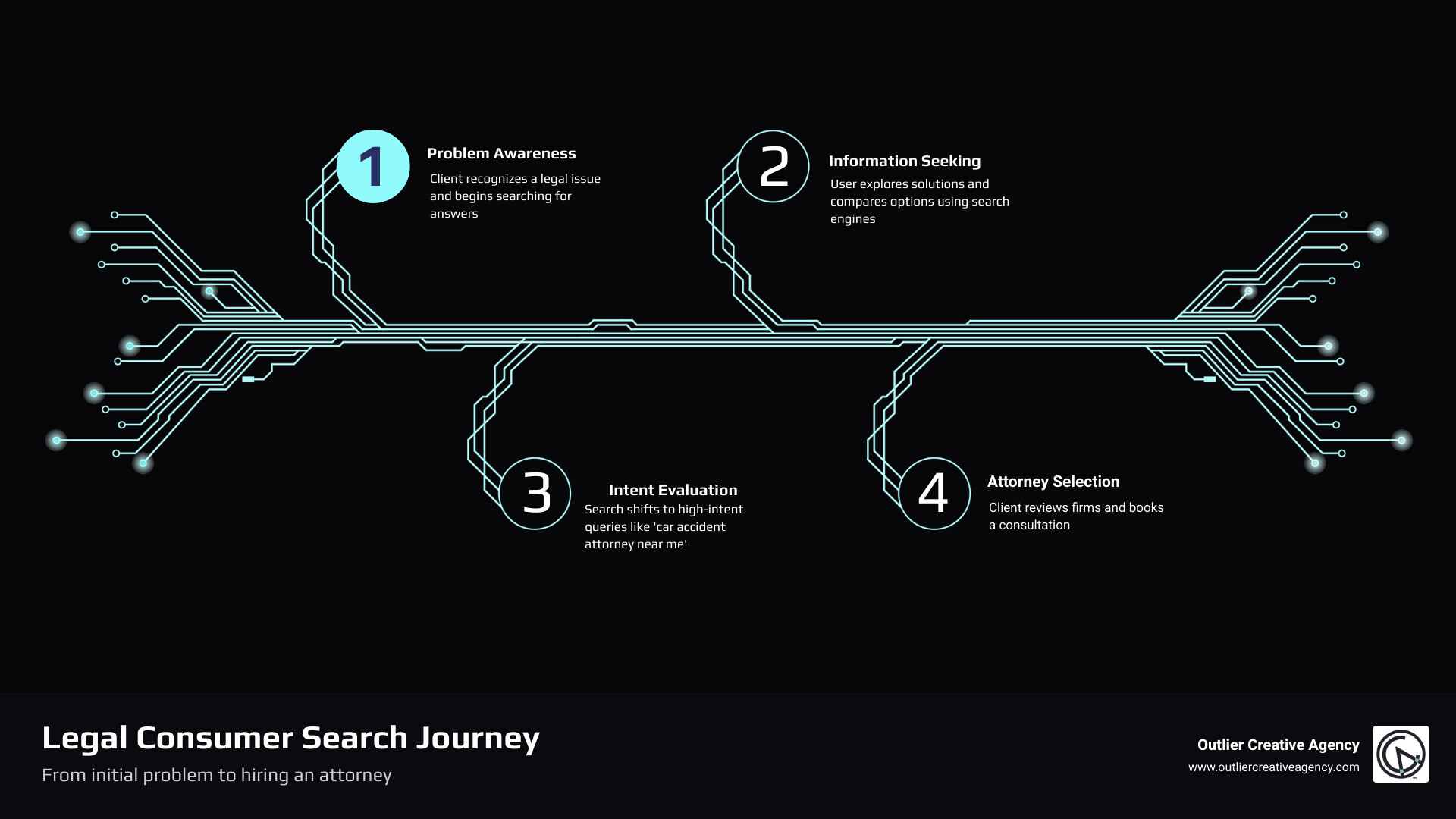
What is Keyword Research Law Firms Need to Master to Win Clients?
At its core, keyword research for law firms is the process of identifying the exact search queries, questions, and phrases that prospective clients type into search engines when they need legal help. But to understand why this is the foundation of your digital growth, we have to look at how search engines actually operate.
Google and other search engines rely on three primary phases to deliver results:
- Crawling: Automated bots scour the internet to discover new and updated content.
- Indexing: Google analyzes and stores this content in a massive database, trying to understand what each page is about.
- Ranking: When a user types in a query, Google pulls the most relevant, high-quality pages from its index to show the user.
To rank highly, your website must demonstrate strong signals of E-E-A-T (Experience, Expertise, Authoritativeness, and Trustworthiness). Google holds legal websites to a higher standard (known as "Your Money or Your Life" or YMYL pages) because legal advice can fundamentally alter a person's financial or physical well-being. Masterful keyword research ensures you are creating content that proves your E-E-A-T while matching search queries perfectly.
Without a targeted keyword strategy, you are essentially whispering in a crowded room. You might write beautiful, legally precise articles, but if they do not target the specific phrases your audience uses, search engines will never index them for the right queries.
Furthermore, the economic case for organic SEO is undeniable. Legal keywords are among the most expensive in digital marketing. Paid search keywords like "personal injury lawyer" can easily exceed $150 to $400+ per click in competitive markets like Los Angeles or Austin. However, a mature organic SEO strategy can deliver highly qualified leads for $50 to $100 each. By building a sustainable pipeline through search, you dramatically lower your overall client acquisition costs (CAC). For a deeper dive into structuring your overall campaign, check out our comprehensive Law Firm SEO Guide.
How Do Legal Consumers Search vs. Traditional Shoppers?
Legal consumers do not search like retail shoppers. If someone wants to buy a pair of running shoes, they might search "best lightweight running shoes 2026." They read reviews, compare prices, and browse casually.
Legal consumers, however, are usually experiencing one of the most stressful periods of their lives. They are dealing with a car accident, a pending divorce, a business dispute, or a sudden arrest. This emotional state deeply impacts their search behavior.
Instead of typing in clean, professional industry terminology, legal consumers use natural language, emotional phrasing, and highly specific questions. They search using phrases like:
- "can my boss fire me for reporting harassment"
- "what happens if I get a DUI in Austin"
- "how to protect my assets in a divorce"
These searches are driven by urgency, fear, and uncertainty. Additionally, because 85% of American adults have a smartphone, these queries are frequently spoken directly into mobile devices via voice search, leading to highly conversational, long-tail search terms.
According to the Clio Legal Trends Report, about 37% of people who hired a lawyer found them through an online search, and 53% of potential clients find attorneys through organic search. If your website only targets sterile, formal phrases like "civil litigation attorney," you will completely miss the massive volume of prospects searching for answers to their immediate, real-world problems.
Why is Understanding Search Intent Critical for Law Firm Keywords?
Search intent is the "why" behind a user's search query. If you do not understand search intent, you will waste time and money writing content that attracts the wrong audience. In the legal industry, search intent generally falls into four distinct categories:
- Informational Intent: The searcher has a question or needs to understand a legal concept.
- Example: "How long do wrongful termination cases take in California?"
- Value: These users aren't ready to hire a lawyer today, but they are seeking clarity. Educational blog posts target this intent, building your authority so they remember your name when they are ready to hire.
- Navigational Intent: The searcher is looking for a specific website or office.
- Example: "Outlier Creative Agency contact page" or "State Bar of Texas login."
- Value: High for brand retention, but low for raw client acquisition.
- Commercial Intent: The user knows they need an attorney and is researching their options.
- Example: "Best personal injury attorney in Los Angeles."
- Value: Extremely high. These users are actively comparing firms, reading reviews, and preparing to make contact.
- Transactional Intent: The user is ready to hire or schedule a consultation immediately.
- Example: "DUI lawyer Austin free consultation."
- Value: The highest. These searches represent active buyers who need immediate representation.
To explore how targeting different intent levels can transform your business, read our in-depth resource on Long-Tail and Intent-Driven Keywords.
What Are the 4 Core Types of Legal Keywords to Target?
An optimized legal website needs a balanced portfolio of keywords. We categorize these into four distinct buckets:
- Primary Commercial Keywords: These are your high-intent "money" keywords. They usually combine your practice area with a geographic location (e.g., "car accident lawyer Austin"). They have high competition and high cost-per-click (CPC) in paid ads, but they bring in clients who are ready to sign.
- Secondary Keywords: These are service-specific variations of your primary terms. Instead of just "family law attorney," secondary keywords target specific issues like "child custody lawyer Los Angeles" or "uncontested divorce attorney."
- Long-Tail Keywords: These are longer, highly specific phrases or questions. While they have lower individual monthly search volume, they collectively represent a massive portion of search traffic, have low competition, and boast incredibly high conversion rates because they match highly qualified, specific scenarios.
- Local Keywords: These focus on localized searches, often utilizing "near me" or highly specific neighborhood/county terms (e.g., "probate lawyer Travis County").
| Keyword Type | Example | Search Volume | Competition | Conversion Rate | Primary Intent |
|---|---|---|---|---|---|
| Primary Commercial | "personal injury lawyer Los Angeles" | High | Very High | High | Commercial |
| Secondary Service | "motorcycle accident attorney Austin" | Medium | Medium-High | High | Commercial / Transactional |
| Long-Tail Question | "can I sue for a rear-end crash in Texas" | Low | Low | Very High | Informational / Commercial |
| Local / Geo-Targeted | "divorce lawyer near me" | High | High | Very High | Transactional |
How Do You Balance Broad Terms and Long-Tail Variations?
Many firms make the mistake of focusing exclusively on broad, high-volume terms like "criminal defense lawyer." While ranking for these terms is great for branding, the competition is fierce, and the conversion rates can actually be lower than highly specific queries.
For example, a broad term like "injury lawyer" has massive search volume but is highly competitive and vague. On the flip side, a long-tail variation like "what to do after a commercial truck accident in Austin" has lower search volume but carries a massive case value and targets a user who is actively seeking highly specialized representation.
By balancing broad commercial terms on your main practice pages and long-tail questions on your blog, you build a comprehensive web of visibility. You capture the urgent, transactional searchers while simultaneously nurturing those who are in the early, research-driven phases of their legal journey.
How Can Your Firm Identify and Prioritize High-Intent Keywords?
To find the keywords that will actually move the needle for your practice, you must look beyond generic search volume. High search volume does not equal high value.
We recommend starting with your own internal data. What questions do your clients ask during their initial consultations? What terms do they use when describing their problems on intake forms? This is your goldmine of "seed keywords"—the raw, real-world phrases that serve as the starting point for your research.
From there, look at your competitors. By analyzing which terms are driving traffic to the top-performing law firm websites in Los Angeles or Austin, you can identify "keyword gaps"—valuable terms that your competitors are ranking for, but you have completely missed.
However, as a law firm, you must also balance your keyword selection with strict ethical considerations. Many state bar associations have rigid advertising rules regarding the use of words like "specialist," "expert," or making subjective claims like "best injury lawyer." When performing keyword research for law firms, always ensure that your target terms and the content you write to support them remain fully compliant with your local bar association's advertising guidelines.
What Step-by-Step Keyword Research Process Can Law Firms Use to Uncover High-Value Terms?
If you want to build a data-backed keyword strategy, follow this battle-tested process:
- Brainstorm Seed Keywords: List your core practice areas and the common questions clients ask. Use wildcards and plural variations (e.g., "probate attorney*", "estate planning lawyer*").
- Utilize Professional SEO Tools: Plug your seed keywords into platforms like Ahrefs, SEMrush, or Google Keyword Planner. This will generate thousands of related search terms along with critical metrics like Monthly Search Volume (MSV) and Keyword Difficulty (KD).
- Filter for Local Intent: Add your geographic modifiers (e.g., "Austin," "Los Angeles," or specific counties and neighborhoods) to focus on the clients in your physical jurisdiction.
- Scout Legal Forums and Q&A Sites: Browse platforms like Avvo, Quora, and Reddit to see how real people phrase their legal worries in natural language.
- Leverage AI for Discovery: Use AI prompts to uncover semantic variations and long-tail questions you might have missed. For a guide on integrating these advanced tools safely, read about AI SEO for Law Firms.
- Analyze Competitor Gaps: Run a competitor domain search in SEMrush or Ahrefs to see what terms are driving their organic consultations, then build superior, more thorough content targeting those exact terms.
Why Are Local SEO and Geo-Targeted Keywords the Secret to Local Dominance?
For law firms, SEO is fundamentally local. Because legal jurisdictions are geographically defined, and because over 75% of consumers use Google to find local service businesses, your local search presence is everything.
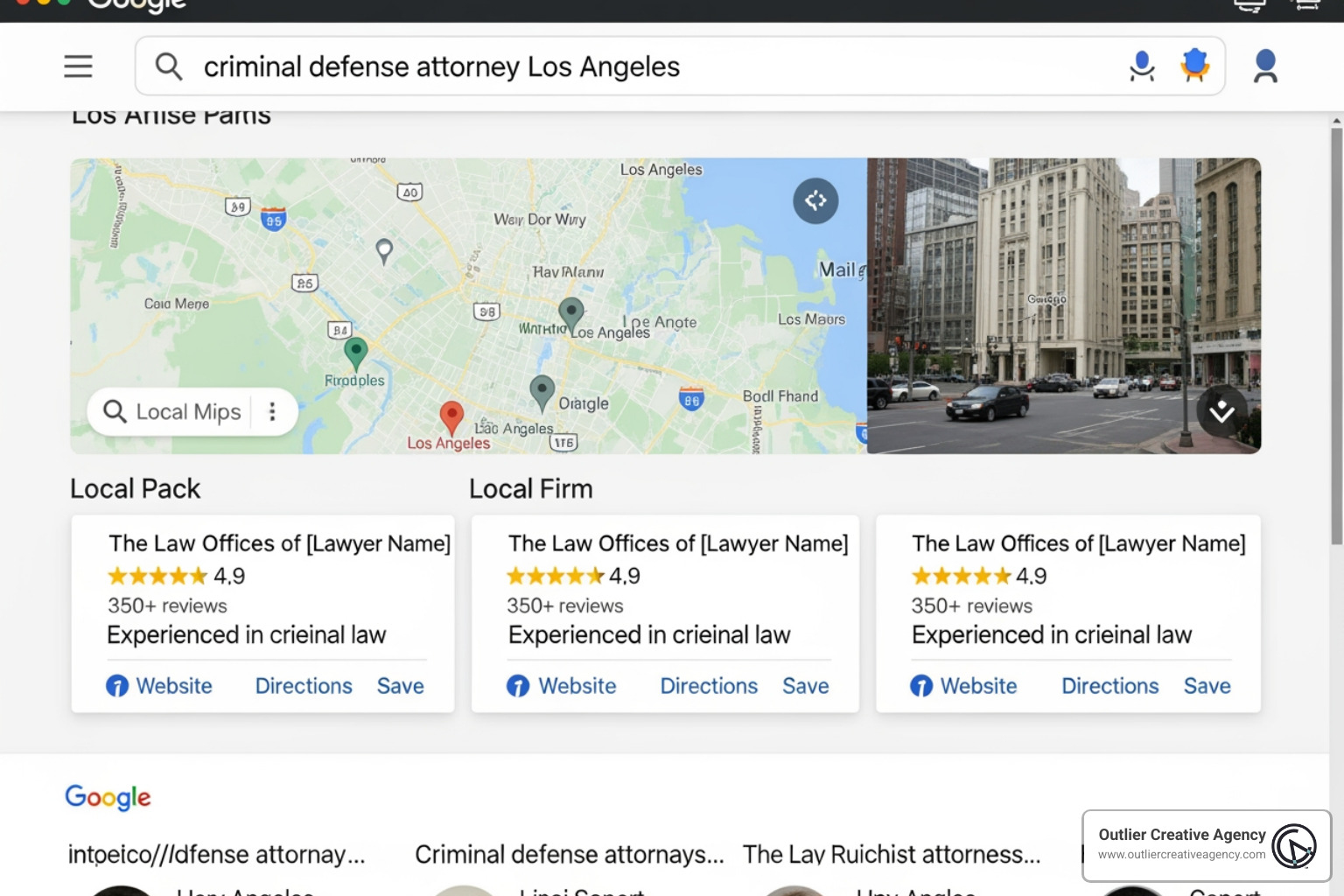
When a user searches for a local service, Google displays the "Local 3-Pack" (or Maps Pack) at the very top of the organic search results. This is highly visible real estate, and ranking here requires a dedicated local SEO strategy.
To dominate local search, you must combine your practice keywords with precise geographic modifiers. This includes:
- City Modifiers: "criminal defense attorney Los Angeles"
- County Modifiers: "probate lawyer Travis County"
- Neighborhood Modifiers: "divorce lawyer Downtown Austin" or "personal injury attorney Santa Monica"
Your Google Business Profile (GBP) is the anchor of your local SEO efforts. To expand your ranking radius and ensure you show up when local prospects search, you must optimize your GBP categories, maintain absolute consistency in your Name, Address, and Phone Number (NAP) across the web, and regularly publish localized content. For a step-by-step checklist to optimize your local presence, check out our Local SEO Checklist.
How Do You Map Keywords to Avoid Cannibalization and Maximize Conversions?
Once you have a list of high-value keywords, you cannot simply scatter them across your website and hope for the best. You need a deliberate keyword map.
Keyword mapping is the process of assigning a specific target keyword (and its close semantic variations, known as a keyword cluster) to a single, dedicated page on your website.
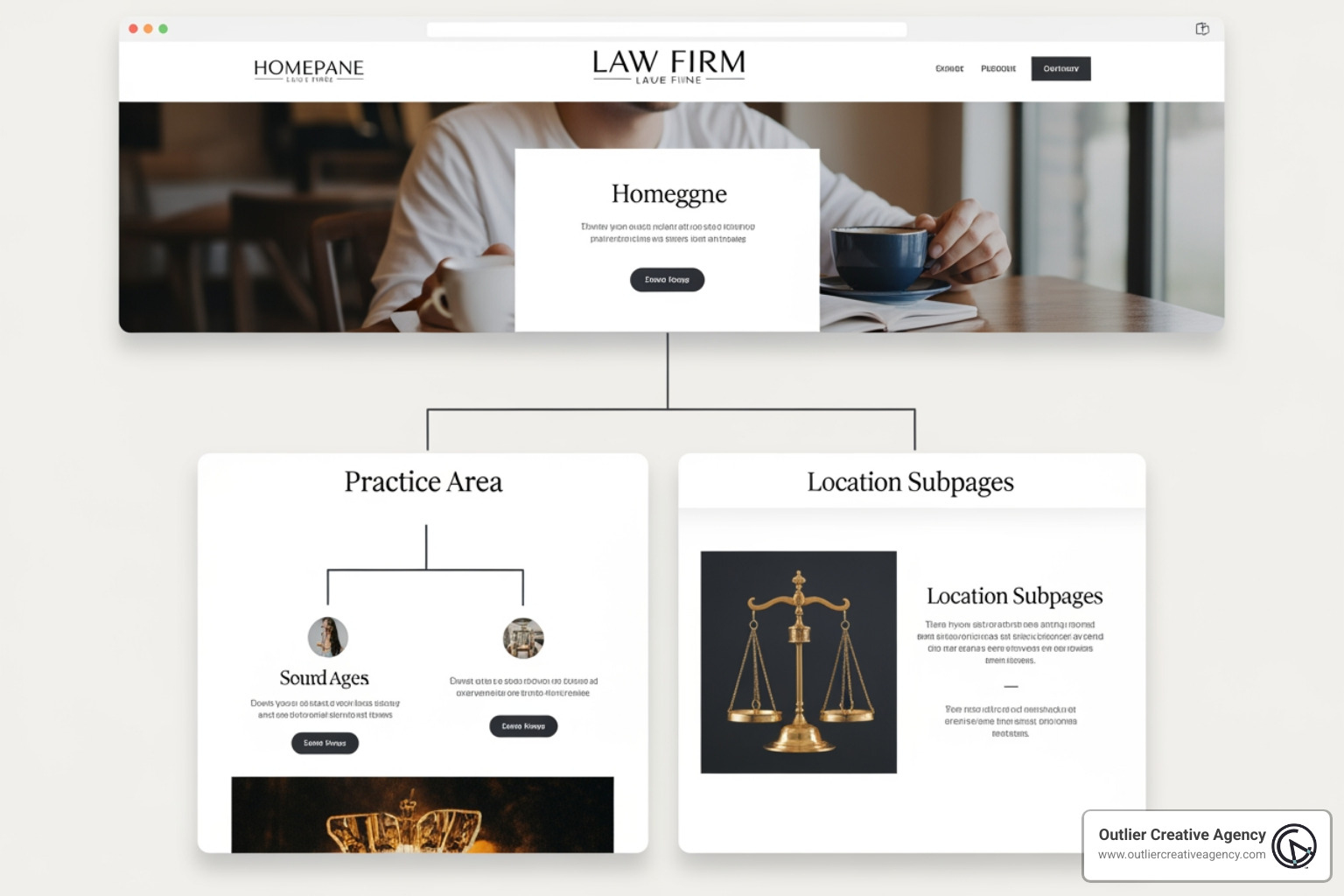
If you skip this step, you risk keyword cannibalization. This occurs when multiple pages on your website target the exact same keyword. When this happens, Google gets confused about which page is the most authoritative, resulting in lower rankings for both pages.
To map your keywords correctly, follow this clean hierarchy:
- Homepage: Target your broadest commercial term (e.g., "Full-Service Law Firm in Austin, TX").
- Practice Area Pages (Money Pages): Target high-intent, primary commercial terms (e.g., "Los Angeles Car Accident Lawyer" or "Austin Estate Planning Attorney"). These pages should be highly comprehensive, averaging 1,500 to 2,500 words, and feature clear Calls to Action (CTAs).
- Sub-Practice or Service Pages: Target secondary keywords (e.g., "Motorcycle Accidents," "Truck Accidents," "Pedestrian Accidents").
- Blog Posts (Informational Content): Target long-tail, question-based keywords (e.g., "Who is at fault in a multi-car pileup in California?"). These blog posts should naturally link back to your main commercial practice pages, driving users down the conversion funnel.
Always build your content to satisfy Google Search Essentials, ensuring that every page serves a clear, distinct purpose for the user.
Frequently Asked Questions about Legal Keyword Research
What is the most common mistake law firms make in keyword research?
The most common mistake is the "spray and pray" approach, where firms target broad, generic keywords (like "lawyer" or "attorney") without considering search intent or local modifiers. This results in spending vast amounts of time or budget to attract national traffic that cannot legally hire them, leading to high bounce rates and zero conversions.
How do local keywords differ from traditional SEO keywords?
Traditional SEO keywords focus on broad, informational topics with a national or global reach. Local keywords incorporate specific geographic indicators (cities, counties, neighborhoods) and target "near me" searches. They trigger Google's local search algorithm, displaying map-based results that prioritize proximity, local reviews, and Google Business Profile optimization.
How long does it take to rank for highly competitive legal keywords?
Ranking for highly competitive legal keywords in major metropolitan areas like Los Angeles or Austin typically takes 6 to 12 months of consistent SEO effort. The timeline depends heavily on your website's existing domain authority, the depth and quality of your content, your local backlink profile, and how effectively you address technical SEO and keyword mapping.
Conclusion
In the competitive legal landscapes of Los Angeles and Austin, winning clients online requires you to stop guessing and start ranking. Keyword research for law firms is not a one-time administrative task; it is the strategic blueprint that dictates whether your digital marketing efforts will generate actual, high-value cases or just empty web traffic.
At Outlier Creative Agency, we specialize in helping attorneys nationwide build authoritative, compliant, and highly visible online presences. We don't believe in generic marketing fluff—we deliver award-winning, data-driven SEO, PPC, and content strategies tailored specifically to the unique nuances of the legal industry.
Ready to dominate your local market and fill your consultation calendar? Let's build a custom SEO strategy that positions your firm as the obvious choice. To pair your search strategy with high-converting visual assets, explore our specialized video production for legal services, or contact us today to schedule your complimentary consultation.