
Why Internet Marketing for Attorneys Has Never Been More Critical
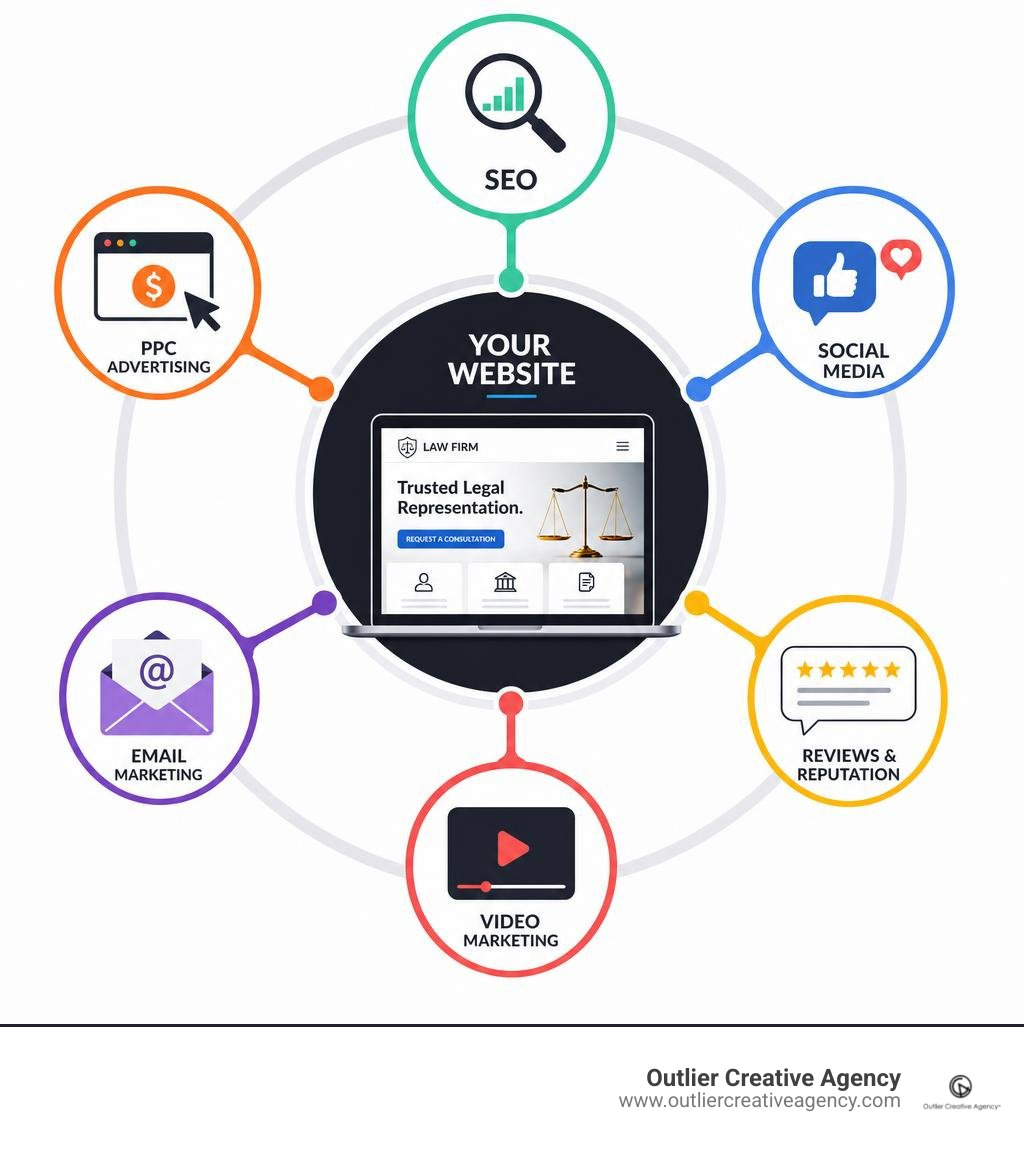
Internet marketing for attorneys is no longer optional — it's the primary way clients find legal help in 2026. Here's what the most effective law firm digital marketing strategy looks like:
- SEO — Build long-term organic visibility for high-intent searches
- Local SEO & Google Business Profile — Dominate the local 3-pack for your city and practice area
- PPC Advertising — Generate immediate leads while organic rankings build
- Content Marketing — Publish educational content that builds trust and authority
- Social Media — Grow brand awareness and drive traffic back to your website
- Reputation Management — Collect and respond to reviews to convert searchers into clients
- Fast Client Intake — Respond within 5 minutes to turn leads into signed cases
The legal industry has undergone a fundamental shift. Referrals and word-of-mouth alone no longer fill a firm's pipeline. Today, 96% of people seeking legal advice start with a search engine — and if your firm isn't visible there, you simply don't exist to them.
The competition is fierce. Over 418,000 law firms operated in the U.S. as of 2024. Most are chasing the same clients, on the same platforms, with the same generic tactics. The firms pulling ahead aren't spending more — they're spending smarter, with documented strategies built around data, compliance, and conversion.
This guide shares 10 hard-won lessons from working inside the legal marketing trenches — what actually works, what quietly drains your budget, and what the highest-growth firms are doing differently.
I'm Corey Larson, founder of Outlier Creative Agency, where we specialize in high-impact content, video, and digital strategy built specifically for law firms navigating the complexities of internet marketing for attorneys. Over the years, we've helped legal professionals cut through the noise with campaigns that are both ethically compliant and genuinely effective — and the lessons below reflect exactly what we've learned doing that work.
The Regulatory and Ethical Guardrails of Internet Marketing for Attorneys
Before spending a single dollar on digital campaigns, we must understand the unique legal framework governing our industry. Unlike traditional businesses, law firms operate under strict ethical rules. A single compliance misstep can lead to state bar disciplinary actions, heavy fines, or compromised reputations.
Lesson 1: Navigating State Bar Rules and Ethical SEO in Internet Marketing for Attorneys
Every piece of content we publish, every keyword we target, and every review we showcase must align with ABA Model Rule 7.1, which strictly prohibits false or misleading communication about a lawyer's services.
When executing Digital Marketing for Attorneys, transparency is our greatest asset. For instance, claiming your firm is the "best personal injury lawyer in Los Angeles" or "most successful criminal defense attorney in Austin" without verifiable, objective data is a direct violation of state bar rules. Instead, we focus on Ethical SEO practices. We build authority by highlighting objective credentials, board certifications, and factual case results accompanied by clear, state-approved disclaimers stating that past results do not guarantee future outcomes.
Another common ethical battleground is competitor keyword advertising. Can you bid on a competing law firm's name in Google Ads? While courts and various ethics boards (such as a notable ruling in New Jersey) generally permit bidding on competitor names as search terms, we must exercise extreme caution. Your actual ad copy must never impersonate the competitor, use their trademarked name in a misleading way, or confuse the searcher into thinking they are contacting the other firm.
Lesson 2: Avoiding Costly Legal Pitfalls in Email, Text, and Website Compliance
We often see firms rush to launch outreach campaigns without understanding the federal regulations that govern digital communications. If you are building contact lists, you must navigate several critical laws:
- The Telephone Consumer Protection Act (TCPA): Heavily regulates text message marketing and automated calls. You must obtain explicit, documented "opt-in" consent before sending text messages to prospective clients.
- CAN-SPAM Act: Governs commercial email. Your emails must include a clear way to opt out, identify your physical office address, and avoid misleading subject lines. Check out our Email Marketing Guide for Lawyers and utilize compliant Law Firm Newsletter Templates to ensure your email workflows remain bulletproof.
- COPPA (Children’s Online Privacy Protection Act): Even general digital campaigns and websites must proactively address privacy laws if they collect data that could belong to minors.
- ADA Website Accessibility: A massive surge in website accessibility lawsuits under the Americans with Disabilities Act (ADA) makes compliance a critical technical requirement. Your website must be fully navigable by screen readers and accessible to individuals with visual or hearing impairments.
Organic vs. Paid: Balancing Search Channels and AI Search
A healthy legal marketing budget balances immediate lead generation with long-term asset building. Understanding the distinct roles of Search Engine Optimization (SEO) and Pay-Per-Click (PPC) advertising prevents firms from burning capital on unsustainable strategies.
Lesson 3: Why SEO is the Foundation of Internet Marketing for Attorneys
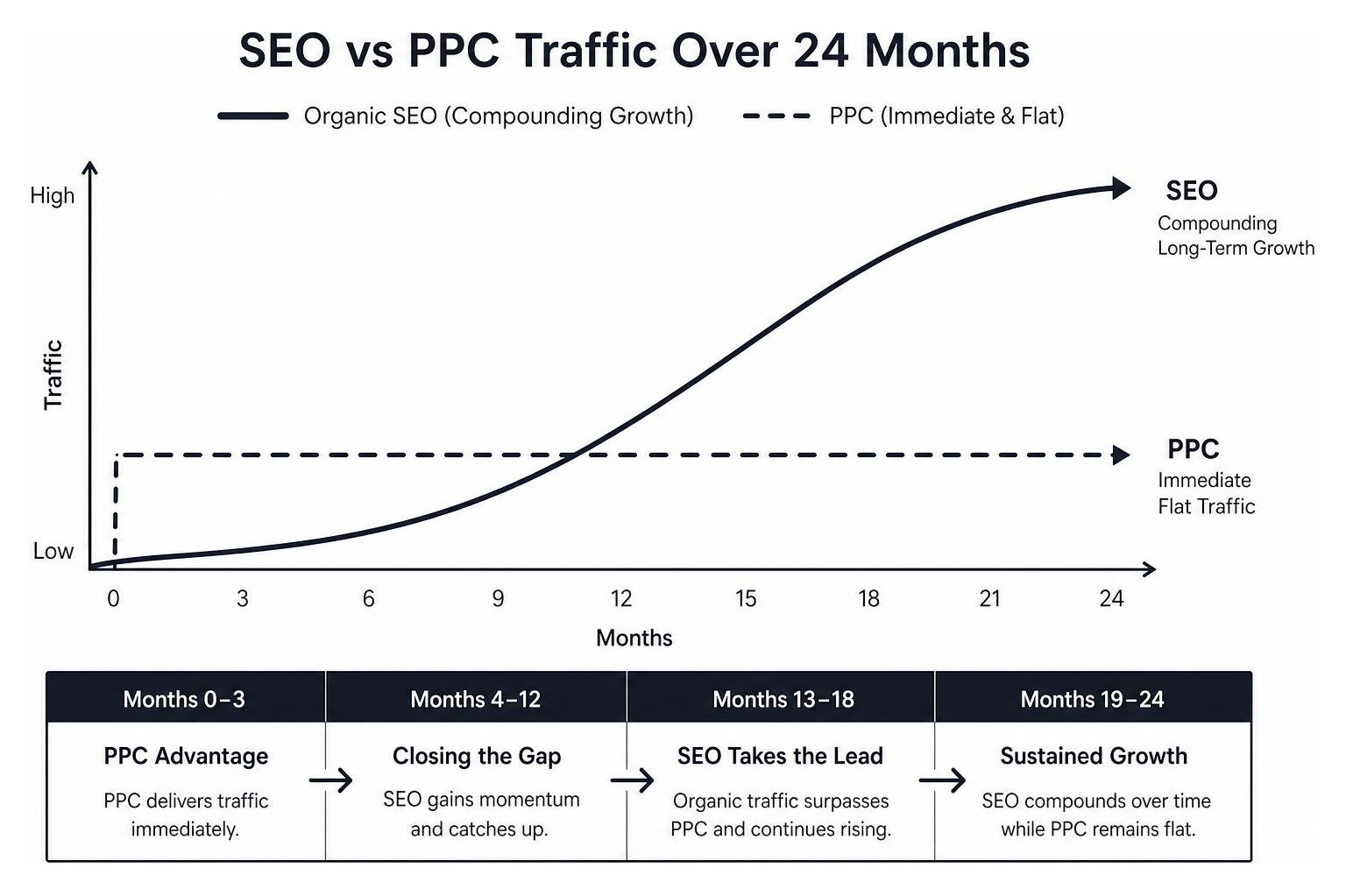
If you treat marketing as an ongoing expense rather than an investment, you will remain trapped on a financial treadmill. Organic search is the single most powerful compounding asset a law firm can own.
According to Law firm marketing statistics for 2026: A comprehensive analysis , SEO generates an average 7.5% conversion rate, which is more than three times higher than PPC's 2.2%. Furthermore, the three-year ROI for an average law firm investing in SEO is approximately 526%, with most campaigns breaking even around the 14-month mark.
When we build out Law Firms Digital Marketing structures, we prioritize organic visibility because it establishes long-term credibility. When learning How to Market Law Firm websites, you must optimize for Google’s E-E-A-T guidelines (Experience, Expertise, Authoritativeness, and Trustworthiness). This means ensuring that legal content is authored or thoroughly reviewed by licensed attorneys, complete with visible bar credentials and active author bios.
Lesson 4: PPC is a High-Cost Rent, Not a Compounding Asset
Paid search is highly effective for turning on immediate lead flow, but it comes at a steep price. Bidding on high-intent keywords like "car accident lawyer" or "personal injury attorney" in competitive markets like Los Angeles or Austin can easily exceed $150 to $300 per single click.
In fact, acquiring a single signed case through paid channels typically costs between $2,500 and $3,000. If you turn off your ad budget tomorrow, your leads immediately drop to zero.
When utilizing PPC for Attorneys, we treat it as a tactical tool to capture immediate cases while our organic foundation builds. To prevent wasting budget, work with a specialized Law Firm PPC Agency that understands negative keyword optimization, landing page conversion design, and localized targeting. Proper Attorney PPC Advertising requires continuous monitoring to ensure you aren't paying for irrelevant clicks or out-of-market searchers.
Lesson 5: AI Search and Google AI Overviews are Rewriting the Playbook
The search landscape in 2026 is vastly different than it was just a couple of years ago. Generative AI search engines like ChatGPT, Perplexity, and Google's AI Overviews (AIO) have changed how consumers find answers.
AI Overviews now appear in up to 60% of legal searches. This shift has caused organic click-through rates (CTR) to drop by 61% for standard listings, because the AI answers the user's question directly on the search page. However, there is a massive silver lining: if the AI Overview cites your website as a source, your page earns 35% more clicks than a traditional organic result.
To optimize for AI engine discovery (Generative Engine Optimization or GEO), we must structure our content to be easily read and cited by AI models:
- Create self-contained answers: Include clear, concise summaries of 50–170 words directly under question-based H2 headings.
- Implement Schema Markup: Use structured data to help AI crawlers easily identify authors, jurisdictions, and practice areas.
- Focus on unique, expert insights: AI search tools cite pages that offer deep, specialized legal analysis, not generic articles that repeat basic definitions.
Operational Realities: Client Intake, Speed-to-Lead, and Reputation
Many firms believe their marketing is failing when, in reality, their operational intake is dropping the ball. You can run the most sophisticated campaigns in the world, but if your internal processes cannot handle the leads, your ROI will suffer.

Lesson 6: Speed-to-Lead is the Ultimate Conversion Metric
The nationwide average new-call-to-case conversion rate for law firms is just 7%, though highly optimized firms reach up to 30%. A major reason for this low average is simple: firms aren't answering the phone. Secret shopper studies reveal that only 40% of law firms answer inbound phone calls, meaning 60% of marketing-driven leads go directly to voicemail.
In digital marketing, speed-to-lead is everything. Law firms that respond to an inquiry within the first five minutes see a 400% higher conversion rate than those that wait longer. Modern consumers have zero patience; if you don't answer, they will simply click the next search result.
We highly recommend implementing robust Marketing Automation and Lead Generation systems. By integrating automated intake systems, e-signatures, and instant SMS auto-responders, you ensure that every lead is engaged the second they submit a contact form.
Lesson 7: Local SEO and Google Business Profile Optimization Drive the Highest Intent Leads
For local practices, the Google Local 3-Pack is the holy grail. Approximately 42% of legal searchers click a result inside the Local 3-Pack, and those firms capture 93% more conversion actions than competitors ranked in positions 4 through 10.
To dominate local search in highly competitive metropolitan areas, you need a localized approach. If you are targeting Southern California, implementing Los Angeles SEO for Lawyers requires hyper-local tactics, just as northern firms must focus on San Francisco Law Firm SEO to stand out.
Key local SEO ranking factors include:
- NAP Consistency: Ensure your Name, Address, and Phone number are identical across all legal directories (Avvo, Justia, FindLaw) and your Google Business Profile.
- Review Recency and Volume: Google prioritizes active firms. Earning 10 reviews in the last three months is far more valuable than having 50 reviews from three years ago.
- Local Backlinks: Earn authoritative links from local chambers of commerce, local news outlets, and neighborhood associations to signal your physical relevance to search engines.
Content and Automation: Scaling Your Firm's Reach
To scale your firm's reach without burning out your staff, you must leverage structured content distribution and automation tools.
Lesson 8: Social Media is a Trust Builder, Not a Direct Lead Generator
While 71% of law firms use social media marketing to connect with prospects, and 84% generate leads through organic social channels, it is rarely a direct source of immediate cases. Instead, social media acts as a critical validation tool. Prospective clients use it to research your firm, assess your culture, and verify your expertise.
We recommend the "hub-and-spoke" model. Your website is the hub (the only digital asset you fully control), and your social channels are the spokes designed to drive traffic back to that hub.
| Platform | Optimal Posting Frequency | Target Audience & Strategy |
|---|---|---|
| 2–3 times per week | B2B, referral networks, professional estate planning, corporate law | |
| 3–4 times per week | Consumer law, family law, personal injury, community engagement | |
| 3–4 times per week | Visual branding, firm culture, community involvement, video shorts | |
| YouTube / TikTok | 1–2 videos per week | Educational legal guides, answering FAQs, building personal authority |
Lesson 9: Video Content and Video SEO Build Unmatched E-E-A-T
Video is the fastest way to build trust with someone who has never met you. Seeing your face and hearing your voice demystifies the legal process and immediately lowers a prospect's defensive barriers.
By producing SEO Optimized Lawyer Videos for platforms like YouTube, TikTok, and your own website landing pages, you answer common legal questions while simultaneously boosting your search rankings. Video content is highly favored by search algorithms and can be repurposed across email newsletters, social media posts, and local landing pages to maximize your production ROI.
Lesson 10: Marketing Automation and Strategic Budgeting Prevent Cash Burn
Most law firms allocate 2% to 10% of their total revenue toward marketing and client acquisition. However, only 47% of law firms maintain an annual marketing budget. Without a documented plan, it is incredibly easy to burn through cash on disjointed campaigns.
We advise our clients to keep a 75/25 search budget split—allocating 75% of their search budget to compounding organic SEO and 25% to immediate PPC ads. Additionally, deploying Marketing Automation Tools for lead nurturing and conducting rigorous Keyword Research Law Firms ensure that every dollar spent is directed toward high-intent, profitable search terms.
Frequently Asked Questions about Legal Marketing
How long does it take to see results from law firm SEO?
Law firm SEO typically takes 3 to 6 months to begin showing meaningful shifts in rankings and organic traffic. Because search engine algorithms require time to crawl, index, and establish trust in your content, organic growth compounds over 12 to 24 months. Most firms reach their break-even point on their SEO investment around month 14, yielding an impressive average 526% ROI over three years.
Can law firms bid on competitor names in Google Ads?
Yes, bidding on competitor brand names in Google Ads is legally and ethically permissible in most jurisdictions, provided your ad copy does not mislead searchers, use trademarked terms in a confusing manner, or violate state bar rules regarding deceptive advertising. It is highly recommended to consult with a specialized agency to design compliant competitor campaigns.
What is the ideal marketing budget for a growing law firm?
A growing law firm should typically allocate 5% to 10% of its gross revenue to marketing and client acquisition. High-growth firms often invest up to 12% to aggressively capture market share. For balanced growth, we recommend a 75/25 split between long-term organic search engine optimization and immediate paid acquisition channels.
Conclusion

Navigating the competitive landscape of internet marketing for attorneys requires a careful balance of data-driven strategy, operational speed, and strict ethical compliance. The firms that dominate their local markets in 2026 are those that treat marketing as a compounding business asset rather than a monthly expense.
At Outlier Creative Agency, we are proud to be an award-winning, full-service digital marketing partner serving law firms nationwide. From our primary offices in Los Angeles, California, and Austin, Texas, we deliver innovative, compliant marketing strategies designed to scale your caseload and build an authoritative online presence.
Ready to stop guessing and start growing? Explore our comprehensive Services, review our successful Case Studies, or schedule a personalized strategy consultation to learn how we can scale your firm's digital footprint.
Book your law firm marketing consultation with Outlier Creative Agency today.