
Why Ethical SEO Is the Only Safe Growth Strategy for Law Firms
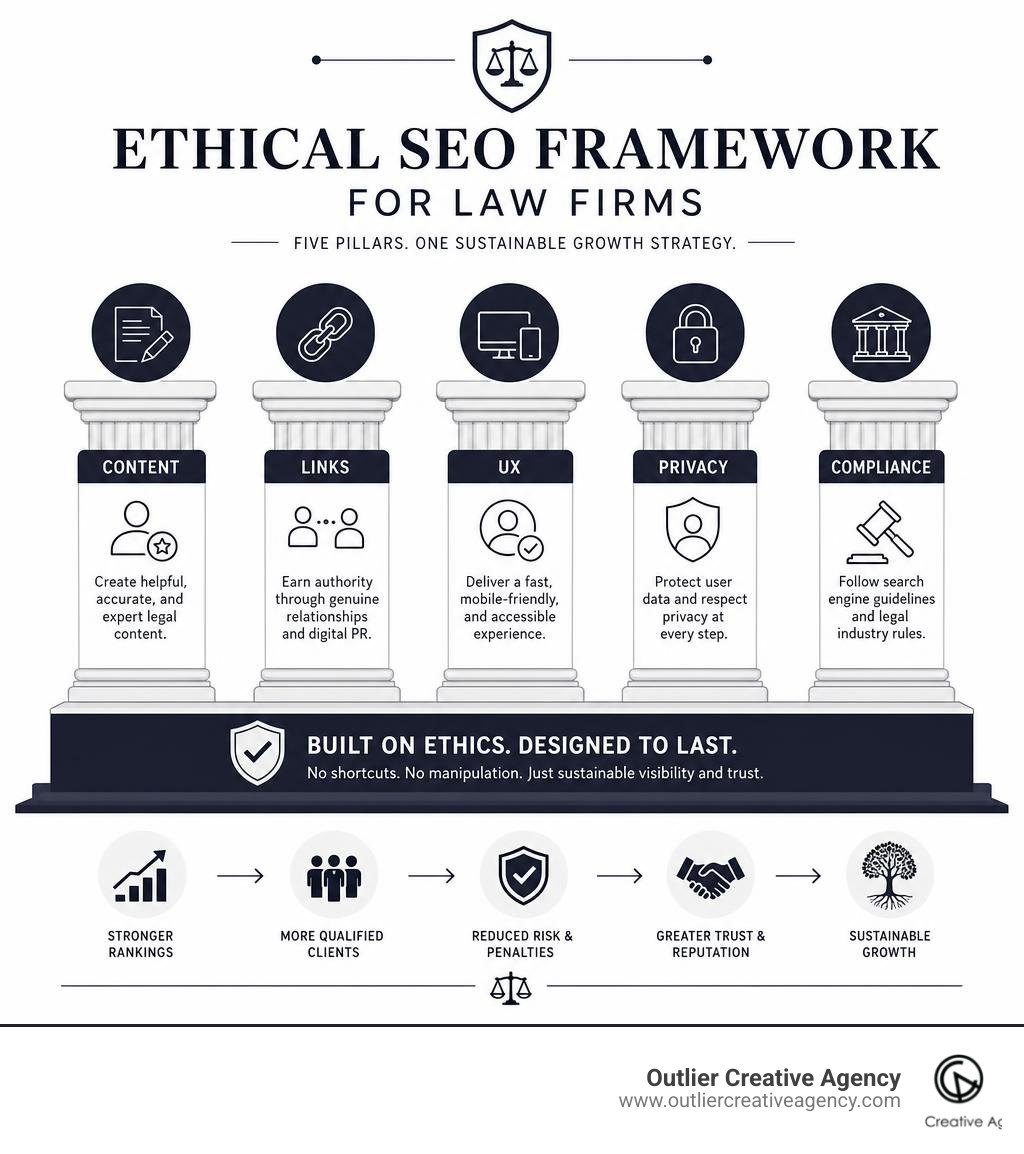
Ethical SEO is the practice of improving your law firm's search rankings by following search engine guidelines, prioritizing user experience, and building genuine authority — without shortcuts that can get your site penalized or your reputation damaged.
If you're evaluating ethical SEO practices for your firm, here's what you need to know at a glance:
| Practice | Ethical SEO | Unethical SEO |
|---|---|---|
| Content approach | Helpful, expert-written, sourced | Keyword-stuffed, thin, or AI-spun |
| Link building | Earned through outreach and PR | Bought, farmed, or traded |
| Search engine compliance | Follows Google's guidelines | Exploits loopholes |
| Risk level | Low — compounds over time | High — penalties can erase rankings overnight |
| Long-term results | Stable and growing | Short spikes, then drops |
Here's the uncomfortable truth: some SEO tactics work fast — until they don't. For law firms, the stakes are especially high. Legal content falls under Google's YMYL (Your Money or Your Life) category, meaning Google holds it to a stricter standard than almost any other industry. A penalty doesn't just hurt your traffic — it can cost you cases.
And it's not just Google you're answering to. Bar association advertising rules, GDPR compliance, and the rise of AI-powered search engines have made how you build visibility just as important as whether you rank at all.
75% of consumers say they're uncomfortable buying from companies with weak data ethics. For law firms — where trust is everything — that number should get your attention.
I'm Corey Larson, and at Outlier Creative Agency I've spent years helping law firms build the kind of online presence that generates real caseloads through ethical SEO — compliant, sustainable, and built to last. In this guide, I'll walk you through exactly what that looks like in practice, what to avoid, and how to grow your firm's visibility without cutting corners.
What is Ethical SEO and How Does It Protect Your Law Firm?
To understand how ethical SEO (often called "white-hat SEO") protects your legal practice, we have to look at it through two distinct lenses: search engine guidelines and legal industry ethics.
In the broader digital marketing landscape, white-hat SEO is about aligning your website with search engine algorithms by delivering real value to human searchers. Black-hat SEO, on the other hand, relies on deceptive shortcuts designed to trick search engine crawlers into ranking a page higher than it deserves.
For law firms operating in competitive markets like Los Angeles or Austin, this distinction is not just a matter of marketing theory. It is a matter of professional survival.
Every state bar association has strict rules governing legal advertising. In California, for example, the Rules of Professional Conduct (specifically Rule 7.1) prohibit lawyers from making false or misleading communications. This includes making guarantees about outcomes or creating unjustified expectations. When an aggressive, unethical SEO provider writes low-quality, sensationalized blog posts or uses deceptive clickbait titles to artificially inflate click-through rates, they may be actively violating your state's bar rules.
Search engine guidelines are designed to reward the same things your clients value: honesty, transparency, and deep expertise. When you prioritize ethical seo, you ensure that your digital marketing strategy remains entirely defensible under regulatory scrutiny. You are building a brand that can withstand both a manual review by a Google Quality Rater and an inquiry from a grievance committee.
To see how these principles contrast in everyday practice, review the framework below:
| Marketing Pillar | Ethical SEO (White-Hat) | Unethical SEO (Black-Hat) | Legal Compliance Risk |
|---|---|---|---|
| Content Strategy | In-depth, attorney-reviewed guides citing primary legal sources. | Mass-produced, AI-generated pages targeting minor keyword variations. | High risk of violating bar rules on misleading claims if unreviewed. |
| Link Acquisition | Earning editorial links from local business groups, legal directories, and news outlets. | Buying cheap backlinks in bulk from private blog networks (PBNs) or link farms. | Potential violation of rules regarding paying for recommendations or referrals. |
| User Experience | Fast-loading, accessible, secure website design with clear navigation. | Intrusive pop-ups, hidden text, and deceptive redirects to manipulate traffic. | ADA non-compliance risks and severe damage to client trust. |
| Data Privacy | Privacy-compliant analytics, clear cookie consent banners, and secure intake forms. | Shadow tracking scripts and invasive behavioral profiling without user consent. | High risk of violating modern privacy frameworks and attorney-client trust. |
Choosing the ethical path means recognizing that search engines are simply a medium to scale your business. Because Google ultimately controls the search engine platform, trying to outsmart their engineers is a losing battle. Instead, aligning your website with long-term user value is the only way to build a sustainable, penalty-proof digital asset.
Why Does Sustainable Search Visibility Matter for Long-Term Legal Practice Growth?
It is easy to get lured in by agencies promising "instant rankings" or "guaranteed page-one placement." However, in the legal industry, these promises are massive red flags. Reputable agencies focus on sustainable growth, transparency, and compliance with search engine guidelines rather than shortcuts.
The reality of modern search is that search engine algorithms are incredibly sophisticated. Gone are the days when a few keyword-stuffed pages and a handful of bought links could secure a top spot. Today, Google's algorithms are built to evaluate real-world authority and trust.
When a law firm uses unethical shortcuts, the consequences are rarely limited to a temporary dip in traffic. A severe search engine penalty can completely de-index your website, erasing years of hard work and thousands of dollars in investment overnight. If your firm relies on organic search to generate personal injury, family law, or criminal defense leads, being removed from Google's index is the equivalent of having your physical office sign torn down and your phone lines cut.
Furthermore, Google's updates are increasingly targeting low-quality, manipulative content. For instance, the significant Core Update in late 2025 sent shockwaves through the legal and medical sectors. Because legal search queries fall directly under the YMYL classification, Google applied its quality standards with extreme rigor. In fact, data showed that 67% of YMYL sites experienced measurable visibility changes immediately following that update. Firms that relied on thin, unverified content or manipulative link-building strategies saw their traffic collapse, while those focusing on deep, compounding authority experienced steady growth.
To protect your brand reputation and ensure long-term growth, your SEO strategy must align with Google's core quality standards. Google outlines these expectations clearly in the Google Search Essentials (formerly Webmaster Guidelines). These guidelines emphasize that your content should be created primarily for users, not search engines, and that you must avoid deceptive techniques intended to manipulate rankings.
By building your search strategy around the principles of E-E-A-T (Experience, Expertise, Authoritativeness, and Trustworthiness), you create an online presence that naturally aligns with what both search engines and prospective clients are looking for. Trust is the ultimate currency in the legal field. If a frightened or confused consumer lands on a website that feels manipulative, cluttered, or deceptive, they will click away instantly. Ethical SEO ensures that when they find you, they find a professional, trustworthy resource.
What Are the Core Pillars of an Ethical SEO Strategy for Law Firms?
An ethical SEO strategy is built on a foundation of three core pillars: helpful content, natural link building, and an exceptional user experience. When these three elements work together, they create a compounding effect that drives sustainable organic traffic and high-quality leads.

At Outlier Creative Agency, we believe that your website design should be just as professional and accessible as your physical office. A secure, fast-loading, and mobile-responsive design is not just a technical ranking factor; it is a critical component of user trust. If you want to see how we integrate these elements, you can explore our SEO Services and check out our regular updates on our Blog. For firms that handle specialized niches, we also offer tailored strategies like Medical SEO to ensure compliance across overlapping high-stakes fields.
Let’s look at how to execute the content and link-building pillars ethically and effectively.
How Do You Craft Helpful, Authoritative Content Under YMYL Standards?
Because legal advice can fundamentally alter a person's financial stability, freedom, and well-being, Google categorizes legal websites as YMYL. This means your content must meet the highest standards of accuracy and authority.
To rank in competitive legal markets, your content cannot be a collection of shallow, 500-word blog posts that merely define basic legal terms. An analysis of top-ranking legal content reveals that pages occupying positions 1 to 3 for competitive keywords average 2,847 words of comprehensive, substantive depth. In comparison, pages ranking in positions 11 to 20 average only 1,123 words.
To build true authority under YMYL standards:
- Write with Depth: Instead of a generic post about "What to do after a car accident," create an exhaustive guide that covers local filing deadlines, how to obtain police reports in your specific municipality, and how insurance companies evaluate claims.
- Include Expert Bylines: Every piece of legal content on your site should be attributed to a named, credentialed attorney. Include a clear author bio that links directly to the attorney's profile page, showcasing their bar admissions, education, and years of experience.
- Cite Primary Sources: Back up every legal claim with links to primary sources, such as specific state statutes, court rules, or official government portals.
- Keep Content Current: Laws change, and outdated legal information is a major E-E-A-T failure. Audit your practice area pages and blog posts quarterly to ensure all information remains accurate and legally compliant.
How Can Law Firms Earn Natural Backlinks Without Violating Bar Advertising Rules?
Backlinks remain one of the most powerful ranking factors in search engine optimization, accounting for roughly 13% of the core algorithm weight according to industry benchmarks. However, link building is also the area where many law firms run into ethical and regulatory trouble.
Buying links, participating in private blog networks (PBNs), or using automated link-building software are direct violations of search engine guidelines. Furthermore, paying for backlinks can violate bar rules regarding paying for referrals or recommendations. Under ABA Model Rule 7.1: Communications Concerning a Lawyer's Services, lawyers must ensure all communications about their services are completely truthful and not misleading. Earning links naturally is the only way to build authority without risking your license.
Ethical link building is about creating "human-value" links — links that would still be valuable to your firm even if Google disappeared tomorrow. To do this:
- Leverage Digital PR: Create original, data-driven resources that journalists and industry publications want to cite. For example, a local car accident firm can compile and analyze annual city traffic data to publish a report on the most dangerous intersections in Austin or Los Angeles.
- Utilize Legal Directories: Ensure your firm is listed on reputable, high-authority legal directories like Avvo, Justia, and Martindale-Hubbell, maintaining perfectly consistent Name, Address, and Phone (NAP) data.
- Engage in Community Outreach: Support local non-profits, sponsor local bar association events, or establish a scholarship program. These genuine community involvements naturally earn high-quality, local backlinks from educational (.edu) and community websites.
Which Unethical SEO Tactics Can Get Your Law Firm Penalized?
When an agency uses manipulative tactics, they are putting your entire practice at risk. If you are currently working with an agency and aren't sure what they are doing, it is critical to audit their work immediately.

Here are the most common unethical SEO tactics that can result in severe search engine penalties:
- Keyword Stuffing: Repeating target keywords excessively in an unnatural way to manipulate search crawlers. This makes your content unreadable and signals to Google that your site is low-quality.
- Cloaking: Presenting one version of a webpage to search engine crawlers while showing a completely different version to human visitors. This is a direct violation of Google's guidelines and a quick way to get de-indexed.
- Hidden Text and Links: Hiding keywords or links by making them the same color as the background, setting the font size to zero, or hiding them behind images.
- Negative SEO: An unethical competitor tactic where someone deliberately builds thousands of spammy, low-quality backlinks to your website to trigger a penalty. Earning high-quality, natural links and regularly monitoring your link profile is the best defense against these attacks.
- Buying or Trading Links: Paying webmasters to place links on their sites or participating in excessive link exchange schemes.
How Do You Navigate AI Search, User Privacy, and First-Party Data in 2026?
As we navigate 2026, the SEO landscape is undergoing a massive shift. Search is no longer just about blue links on a page; it is about AI-powered search engines, conversational search, and strict data privacy regulations.
Platforms like Google AI Overviews and ChatGPT are changing how users find information. AI engines compress search results into a single, confident narrative, citing only the most authoritative and trusted sources. Data shows that 55% of AI Overview citations come from the top 30% of a page, meaning your content must answer search queries clearly and directly at the very beginning of your articles.
Additionally, user privacy has become a major trust signal. In an era where third-party cookies are being deprecated and data tracking is heavily restricted, first-party data is gold. 75% of consumers say they feel uneasy buying from companies with weak data ethics. Law firms must adapt by replacing invasive tracking scripts with privacy-friendly analytics and building direct, consented relationships with their audience.
How Do You Align Your Ethical SEO with Modern Privacy Regulations?
To maintain trust and search visibility, law firms must ensure their websites comply with modern privacy frameworks like GDPR, CCPA, and CPRA. Google now requires opt-in consent in many jurisdictions, meaning your analytics tracking must adapt dynamically based on user choices.
Implementing Consent Mode and displaying transparent, easy-to-use cookie consent banners are no longer optional. The financial stakes of non-compliance are massive, with global GDPR fines exceeding €5.6 billion, and tech giants facing historic penalties. For law firms, a privacy breach or non-compliant tracking setup can also lead to professional ethics investigations.
To transition your firm to a privacy-first marketing model, we recommend reading our Law Firm PPC Analytics Guide 2026 and our Law Firm PPC Audit Guide 2026. These resources provide actionable steps for setting up compliant tracking systems that protect your firm while still delivering the data you need to measure success.
How Do You Optimize for AI Search Engines Through Ethical SEO Practices?
Optimizing for AI search engines (often called Generative Engine Optimization, or GEO) does not require manipulative tricks. In fact, AI models rely heavily on the same trust signals that Google's core algorithm looks for.
To ensure your law firm is cited in AI search summaries:
- Use Structured Q&A Formatting: Design your content to answer specific questions directly. Lead with a clear, concise answer, then follow with in-depth supporting details and legal context.
- Publish Original Data: AI models are trained on high-authority platforms and editorial publications. By publishing original data studies or unique legal insights, you increase the likelihood of your firm being cited as a primary source.
- Implement Schema Markup: Use structured data honestly to help AI crawlers understand the exact entities on your page, such as your attorneys, your office locations, and your practice areas.
To align your site with these evolving search behaviors, you can consult Google's Guide to AI Overviews and Search Creator Guidelines.
Frequently Asked Questions About Ethical SEO for Lawyers
How long does it take to see results from ethical SEO?
Unlike paid advertising, which can drive traffic instantly but stops the moment you turn off the budget, ethical SEO is a long-term investment. For law firms in competitive markets like Los Angeles or Austin, you can typically expect to see initial movement in rankings and traffic within the first 90 days. Significant, compounding growth and measurable caseload increases generally happen over a 12-month timeline. Ethical search strategies build a sustainable digital asset that continues to generate leads for years to come.
Is buying backlinks ever considered ethical or safe?
No. Buying backlinks is a direct violation of search engine guidelines and is classified as a link scheme. While some agencies try to disguise paid links as "blogger outreach" or "sponsored placements," search engines are highly effective at detecting and penalizing these networks. Earning links through manual outreach, digital PR, and genuine community engagement is the only safe and ethical way to build authority.
Finding a partner who understands legal ethics is critical. While there are thousands of general SEO agencies in major markets like Los Angeles and Austin, very few understand the strict regulatory environment that law firms operate under. Working with an agency that specializes in legal marketing ensures your campaigns remain compliant with state bar rules while still driving meaningful growth.
How do Google's YMYL guidelines affect legal websites?
Google classifies legal websites under YMYL (Your Money or Your Life) because the information you provide can directly impact a user's safety, financial stability, or freedom. Because the stakes are so high, Google holds legal content to a much stricter standard of accuracy, authority, and trustworthiness. To rank well, your content must be written or thoroughly reviewed by credentialed legal professionals, cite primary sources, and be updated regularly to reflect current laws.
Conclusion
Building a successful law practice requires an online presence that is as reputable and professional as your work in the courtroom. Shortcuts might offer temporary spikes, but only ethical SEO delivers the sustainable, penalty-proof growth that allows your firm to thrive over the long term. Whether you are based in Southern California, Central Texas, or anywhere else nationwide, understanding how local search markets operate is key to building a dominant online presence.
For a deeper dive into how ethics and search intersect in the modern AI era, we highly recommend reading Should Ethics Play a Role in SEO/AI? - by Nick LeRoy .
At Outlier Creative Agency, we are dedicated to helping law firms build authoritative, compliant, and highly visible digital brands. Let us handle the complexities of search engine optimization so you can focus on what you do best: representing your clients.
Partner with Outlier Creative Agency for Ethical SEO Services