
Why Digital Marketing for Immigration Attorneys Is Critical in 2026
The legal landscape in 2026 requires law firms to adapt to how prospective clients find legal counsel. Relying solely on word-of-mouth referrals or offline billboards is no longer sufficient to maintain a consistent caseload.
With over 3 million pending cases in the U.S. immigration court system, the demand for qualified legal guidance is high. At the same time, over 17,000 practicing immigration attorneys are competing for these prospective clients. Standing out in a crowded marketplace requires a strategic approach to Digital Marketing for Attorneys.
Immigo-focused legal searches are unique: they are driven by personal urgency, high emotional stakes, and complex regulatory requirements. When individuals face deportation proceedings, apply for employment authorization, or seek family reunification, they turn to search engines to find clear, trustworthy answers.
To capture these high-intent leads, modern Law Firms Digital Marketing must establish credibility before a prospect ever fills out a contact form. Research indicates that over 90% of consumers check online reviews and ratings before contacting a professional service provider. An active digital presence that highlights client testimonials, case outcomes, and authoritative legal content builds immediate trust with families and corporate clients navigating the legal system.
Strategic Roadmap for Immigration Law Firm Growth

Scaling an immigration practice requires an integrated client acquisition framework. A piecemeal approach—such as running ads without an optimized landing page or posting on social media without clear call-to-action prompts—wastes time and marketing budget.
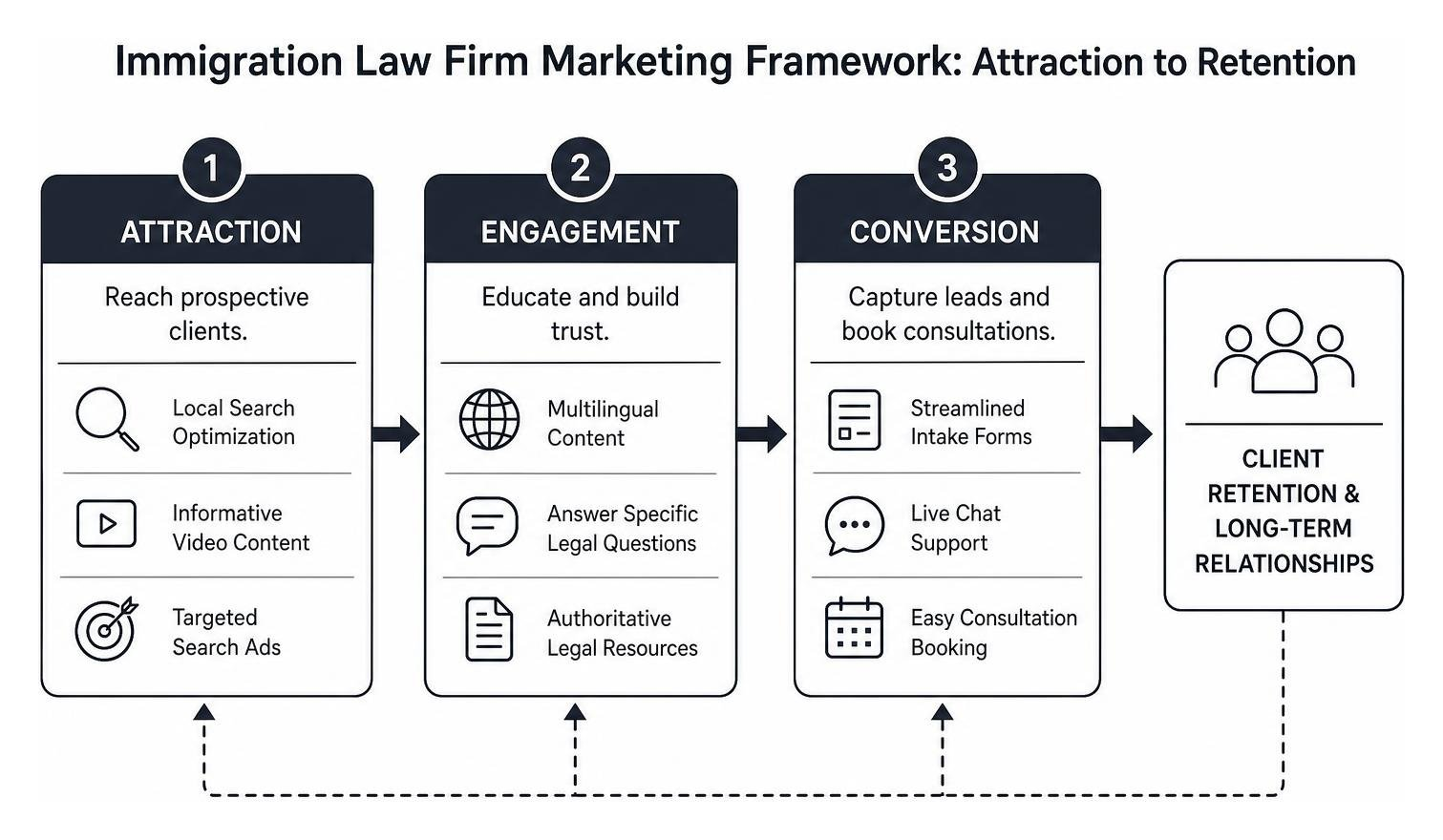
Successful growth models align every digital touchpoint to guide a prospect through their decision-making process:
- Attraction: Reaching prospective clients through local search, informative video content, and targeted search ads.
- Engagement: Educating visitors with multilingual, easy-to-understand content that answers specific legal questions.
- Conversion: Capturing contact details using streamlined intake forms, live chat, and accessible consultation booking links.
- Retention & Referrals: Nurturing past and present clients through targeted email updates to encourage repeat business and peer referrals.
Core Pillars of Digital Marketing for Immigration Attorneys
Your website serves as the primary hub of your firm's digital presence. When a prospect clicks on an ad, reads a blog post, or finds your business on Google Maps, they evaluate your website to determine whether to trust you with their case.
An optimized website for an immigration practice must prioritize fast load times, responsive mobile design, and clear conversion paths. Many immigration clients browse the web primarily on mobile devices, making mobile-first Web Design essential.
To maximize website conversions, incorporate these trust elements across your homepage and landing pages:
- Bilingual and Multilingual Navigation: Clear language selectors so visitors can read content in their primary language.
- Prominent Social Proof: Embedded video testimonials and verified third-party review ratings (e.g., Google, Avvo).
- Security and Accessibility Trust Badges: HTTPS encryption, bar association memberships, and accessible design compliant with ADA standards.
- Direct Calls to Action (CTAs): Simple booking forms, click-to-call phone numbers, and WhatsApp messaging integrations for immediate communication.
Local and Multilingual SEO Strategies
Search engine optimization is critical for capturing prospective clients who are actively searching for legal assistance. When someone searches for an "asylum attorney near me" or "H-1B visa lawyer," ranking prominently on search engine results pages (SERPs) drives qualified traffic directly to your firm.
Effective local search optimization begins with your Google Business Profile. Ensure your firm's name, address, phone number (NAP), office hours, and primary category ("Immigration Attorney") are accurate across all online directories. Regularly collecting positive Google reviews from satisfied clients boosts local map pack rankings in competitive markets.
For a comprehensive approach to Internet Marketing for Attorneys, SEO strategies must also account for multilingual keyword targeting and emerging search technologies, such as AI Overviews (formerly SGE) and Generative Engine Optimization (GEO).
Prospective immigration clients often search using long-tail, conversational queries in their native languages. Developing localized, translated content targeting specific long-tail searches—such as "¿Cómo solicitar una visa U en Texas?" or "Adjustment of status application timeline 2026"—helps your firm capture intent-driven organic traffic that general legal sites miss.
High-Intent PPC and Social Media Advertising
While organic SEO builds long-term authority, pay-per-click advertising offers an effective way to generate immediate, high-intent leads. Running targeted campaigns via search networks allows your firm to display ads directly to users searching for urgent representation.
Using dedicated landing pages for specific practice areas (e.g., deportation defense, investor visas, family petitions) improves Quality Scores, lowers your cost-per-click (CPC), and increases conversion rates.
Simultaneously, paid social campaigns on platforms like Facebook, Instagram, and YouTube allow firms to build brand awareness within specific demographic and cultural communities. For instance, Facebook Groups and targeted demographic ads are effective for family-based immigration, while LinkedIn is better suited for employment-based (EB-1, EB-2 NIW, L-1) and investor visa practices.
| Marketing Channel | Primary Strengths | Ideal Practice Area Focus | Key Performance Metric |
|---|---|---|---|
| Google Search Ads | High intent, immediate lead generation, precise keyword targeting | Immediate need cases: Deportation defense, bond hearings, urgent visa renewals | Cost Per Lead (CPL), Conversion Rate |
| Organic SEO & Local Maps | Sustainable long-term traffic, high trust, lower cost-per-acquisition over time | Local client outreach: Green cards, citizenship, family petitions | Local Mappack Rankings, Organic Traffic |
| Paid Social Media | Demographic targeting, community building, visual storytelling | Family-based petitions, DACA, humanitarian visas, community outreach | Engagement Rate, Cost Per Click (CPC) |
| YouTube Video Marketing | Authority building, complex topic simplification, second-largest search engine | Specialized visa categories, complex immigration guides, client interviews | Video Completion Rate, Subscriber Growth |
YouTube remains an underutilized video platform for law firms. Creating clear, educational videos that address common visa application errors or explain step-by-step policy updates builds trust and positions your team as approachable subject matter experts.
Lead Nurturing via Email Marketing and Educational Content
Immigration legal processes often take months or years. A prospect researching visa options today might not formally retain an attorney for several weeks. Implementing lead-nurturing workflows ensures your firm stays top of mind throughout their decision-making timeline.
Strategic Email Marketing workflows help move leads through your intake funnel:
- Automated Lead Magnets: Offer downloadable, language-specific PDF guides (e.g., "The 2026 Family Green Card Checklist") in exchange for an email address.
- Segmented Follow-Up Sequences: Send series of automated emails based on the lead’s interest (e.g., business immigration vs. humanitarian defense).
- Monthly Regulatory Updates: Send plain-language updates detailing policy changes from USCIS, the Department of State, or EOIR.
Producing educational blog posts, FAQ hubs, and guides reinforces your firm’s domain authority while demonstrating empathy and technical competence.
Measuring Success and Maintaining Advertising Compliance

Data-driven decision-making allows immigration law practices to optimize marketing performance, eliminate wasted ad spend, and generate predictable client intake. However, marketing strategies must strictly adhere to legal ethics and bar regulatory guidelines.
Tracking ROI and Scaling Digital Marketing for Immigration Attorneys
To measure campaign effectiveness, track accurate key performance indicators (KPIs) beyond vanity metrics like page views or social media likes.
Essential metrics to monitor in Google Analytics and intake management software include:
- Cost Per Lead (CPL): Total marketing spend divided by total inbound inquiries generated.
- Cost Per Acquisition (CPA): Total spend divided by the number of signed retainer clients.
- Lead-to-Consultation Rate: The percentage of leads that successfully book an initial consultation.
- Consultation-to-Retainer Rate: The percentage of consultations that sign a client agreement.
For budget planning, a standard recommendation for law firms is allocating 5% to 10% of gross revenue toward marketing. Emerging firms or those expanding into competitive metropolitan markets often allocate higher percentages during initial growth phases. For further insights on structuring your budget, consult our guide on How to Market Law Firm.
Ethical Guidelines and Legal Advertising Compliance
Legal marketing requires strict adherence to legal ethics and State Bar regulations. Violations can lead to disciplinary actions, fines, or reputational damage.
Key legal advertising compliance requirements include:
- Avoid Guarantees: Never promise or guarantee specific case outcomes, visa approvals, or green card timelines in ad copy, social posts, or website text.
- Mandatory Disclaimers: Include clear disclaimers stating that website content is for informational purposes only and does not constitute an attorney-client relationship.
- Transparent Attorney Identification: Ensure all advertisements clearly identify the attorney or firm responsible for the content, including office location and licensing information.
- Authentic Testimonials: Use genuine client reviews and ensure written consent is secured if detailing specific case facts. Adhere to regional regulations regarding dramatizations or paid endorsements.
- Digital Accessibility: Ensure your website complies with Web Content Accessibility Guidelines (WCAG) to support individuals with disabilities and meet federal compliance expectations.
- Consistent Branding: Maintain a consistent professional tone across all channels that accurately reflects your firm's credentials without misleading titles or claims of unverified specialization unless certified by a recognized state bar entity.
Frequently Asked Questions About Immigration Law Marketing
What are the most effective digital marketing strategies for immigration law firms?
The most effective approach combines localized organic search engine optimization (SEO), targeted pay-per-click (PPC) advertising, and bilingual educational content marketing. Optimizing your Google Business Profile ensures visibility in local map searches, while Google Ads captures immediate, high-intent inquiries. Pairing these tactics with educational video content on platforms like YouTube builds audience trust and improves consultation conversion rates.
How much budget should an immigration law firm allocate to marketing?
Most legal marketing benchmarks suggest allocating between 5% and 10% of gross firm revenue toward digital marketing strategies. Solo practitioners and scaling firms entering competitive urban markets often allocate 10% to 15% to capture market share rapidly. Budgets should be distributed across high-performing search channels, website optimization, and content creation, with ongoing reallocations based on tracked Cost Per Acquisition (CPA).
Do immigration lawyers need multilingual marketing?
Yes. Multilingual digital marketing is critical for immigration practices given the demographics of prospective clients. Providing websites, ad campaigns, email workflows, and client intake options in languages such as Spanish, French, Mandarin, or Portuguese expands reach and reduces intake friction. Communicating in a client’s preferred language builds immediate trust and ensures clear legal understanding.
Can small immigration law firms compete online against larger practices?
Yes, smaller firms and solo practitioners can compete by targeting specific legal niches and hyper-local geographic areas. While larger law firms spend heavily on high-volume general keywords, smaller firms can dominate specialized long-tail searches (such as "O-1 visa lawyer for tech founders" or "VAWA petition attorney in Los Angeles"). Focusing on local map optimization, authentic video content, and responsive client service gives smaller practices a distinct competitive edge.
Conclusion
Building a successful digital presence requires a clear strategy, consistent content creation, and ongoing performance monitoring. By establishing a user-friendly, multilingual website, implementing targeted local SEO, executing focused PPC search campaigns, and maintaining absolute ethics compliance, your firm can reliably attract and convert high-intent prospective clients.
To explore real-world examples of successful legal campaigns, view our client success stories in our Case Studies library.
If you are ready to expand your caseload and streamline your digital client acquisition strategy, partner with our legal marketing experts at Outlier Creative Agency. Discover how our specialized campaign strategies, including dedicated PPC Advertising for Law Firms, can help position your firm for predictable growth.