
Is Your Law Firm Invisible Online? Here's What You Need to Know
Digital marketing for attorneys is the practice of using online channels — search engines, websites, paid ads, social media, and content — to attract and convert potential clients into signed cases.
Quick answer: What does digital marketing for attorneys include?
| Channel | What It Does | Timeline |
|---|---|---|
| SEO | Ranks your firm in Google search results | 3-6 months |
| PPC / Google Ads | Drives immediate paid traffic to your site | Immediate |
| Local SEO | Gets your firm into Google Maps / Map Pack | 1-3 months |
| Content Marketing | Builds trust and authority with prospects | Ongoing |
| Social Media | Builds brand awareness and community | Ongoing |
| Email Marketing | Nurtures leads and retains past clients | Ongoing |
| Video Marketing | Educates prospects and boosts conversions | Ongoing |
Here's the reality: 96% of people seeking legal advice use a search engine at some point in their journey. And yet, 43% of law firms still operate without an annual marketing budget.
That gap is your opportunity — or your problem, depending on which side of it you're on.
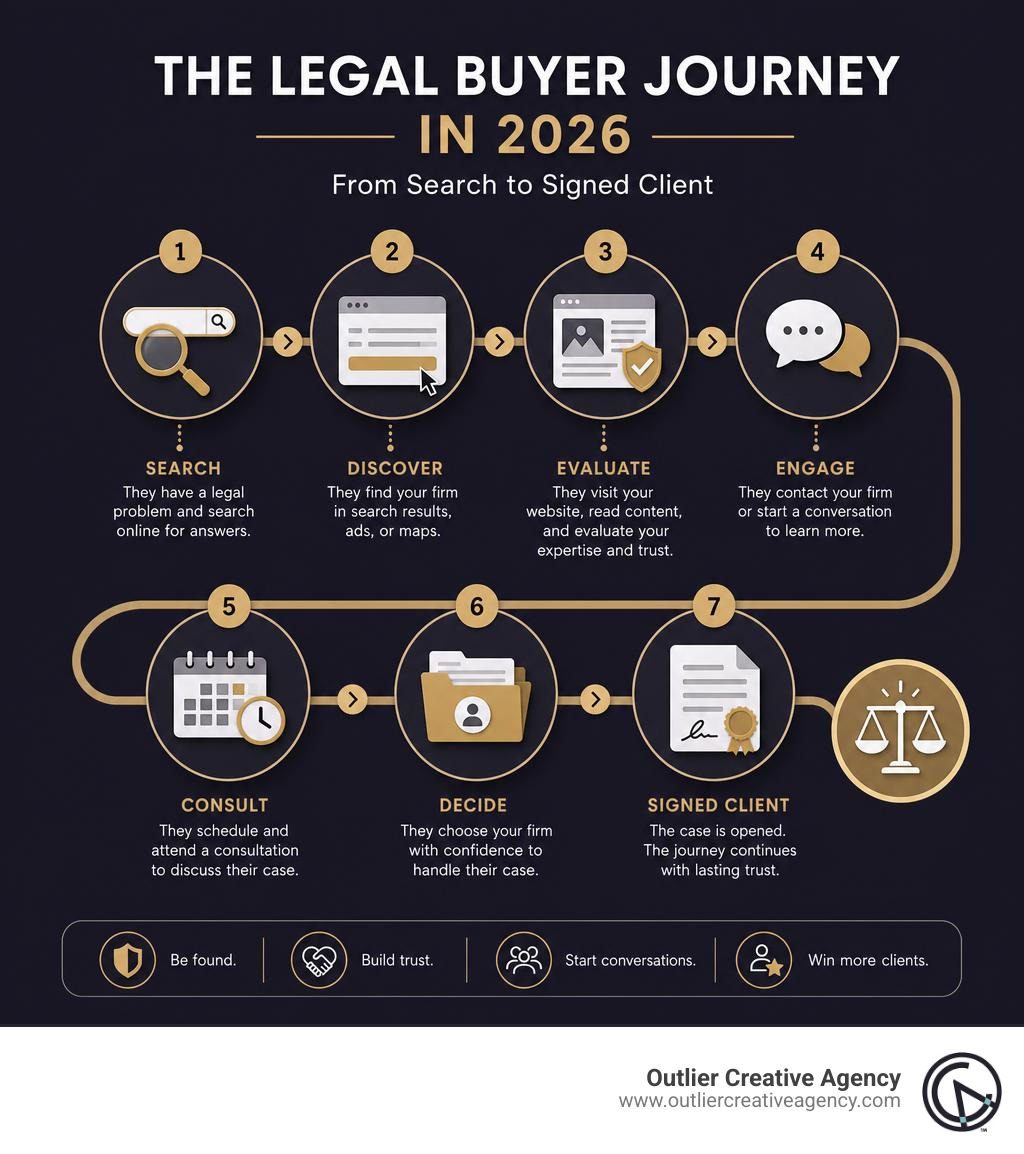
The days of building a practice purely on referrals and word of mouth are fading fast. Today's legal clients research online, compare multiple firms, read reviews, and make decisions before they ever pick up the phone. If your firm isn't showing up where they're looking, you're losing cases to competitors who are.
This guide covers everything a law firm owner or marketing director needs to build a results-driven digital marketing strategy in 2026 — from your website and SEO to paid ads, video, and how to measure every dollar you spend.
I'm Corey Larson, founder of Outlier Creative Agency, where we specialize in high-impact media and content strategies that help law firms stand out and grow their caseloads through smarter digital marketing for attorneys. With experience producing everything from legal websites to video campaigns and social media, I'll walk you through what actually works — and what doesn't.
Why Digital Marketing for Attorneys Is Non-Negotiable in 2026
The legal landscape in competitive metros like Los Angeles and Austin has transformed from a referral-driven cottage industry into a highly sophisticated digital arena. Relying solely on your professional network or a static website is no longer a viable business model.
According to a comprehensive analysis of Law firm marketing statistics for 2026: A comprehensive analysis, approximately 75% of people looking for an attorney begin their search online. Furthermore, 37% of people who ultimately hired a lawyer found them directly through an online search. Because of these shifting behaviors, high-growth law firms are aggressively moving away from traditional channels, with 65% of law firms now allocating the majority of their marketing expenditures to online platforms.
When prospective clients face stressful situations — whether it’s a car accident on the I-10 in Los Angeles or a complex business dispute in downtown Austin — they don't wait for a friend to text them a recommendation. They open their phones and search for immediate answers. If your competitors occupy the top organic search spots, Google Local Services Ads, and local Map Packs, they capture that high-intent traffic before you even get a chance to make an impression.
Investing in digital marketing isn't just about "getting your name out there." It's about establishing digital omnipresence so that when a client needs your exact practice area, your firm is the obvious, authoritative choice. For a deeper look at transitioning your client acquisition strategies, read our guide on How to Attract New Business to Your Law Firm.
Why Your Law Firm Website Is the Foundation of Digital Marketing Success
Think of your website as your digital lobby. Just as you wouldn’t welcome a high-value client into a messy, outdated physical office, you cannot afford to send valuable traffic to a slow, confusing website.
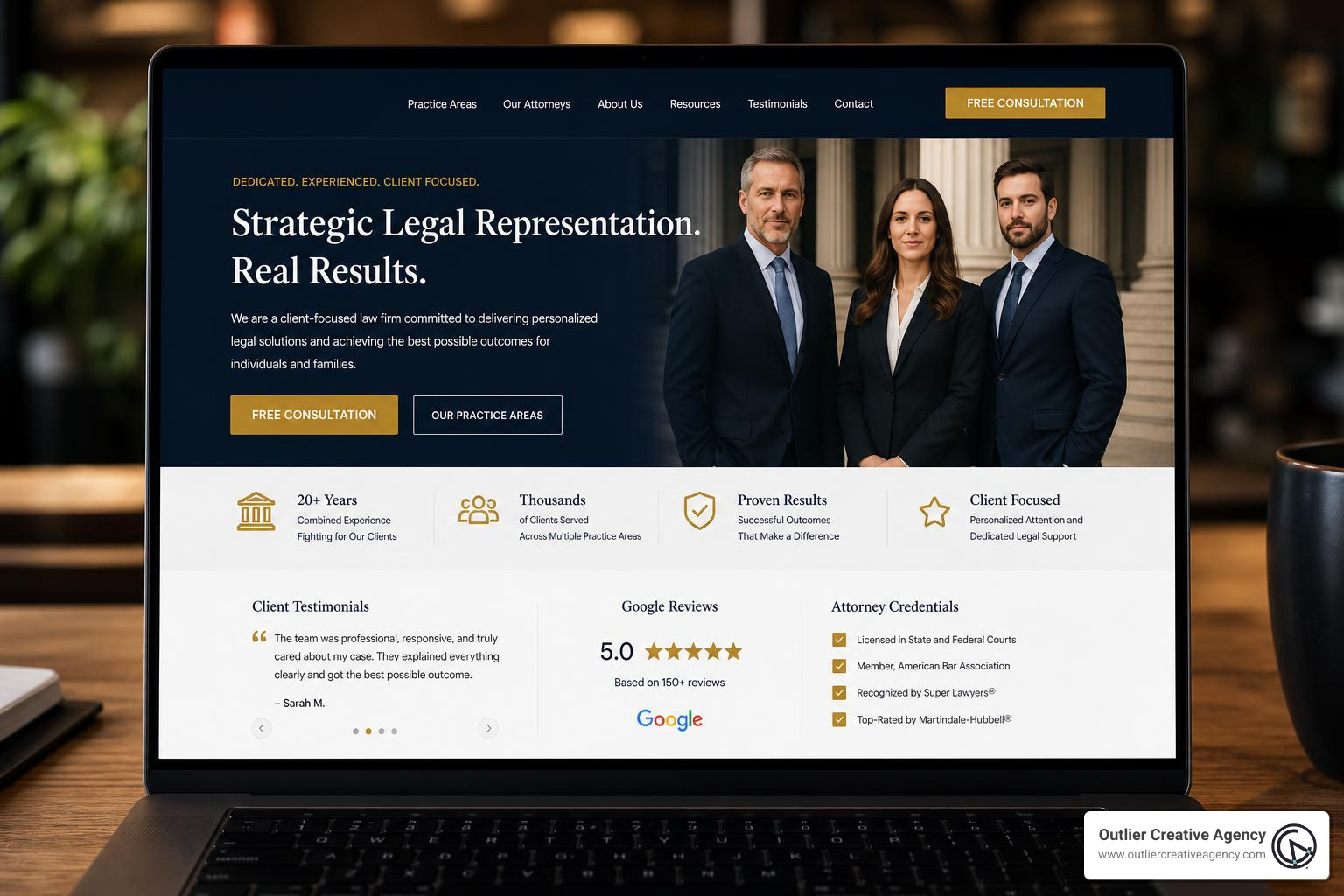
A staggering 70% of prospective clients visit multiple law firm websites before deciding on representation. If your site has a slow loading speed — even a one-second delay can increase bounce rates by up to 32% — or lacks clear navigation, those prospects will immediately click away to a competitor.
To convert modern legal searchers into signed cases, your website must be built around several core pillars:
- Mobile-First Design: With over 60% of legal searches occurring on mobile devices, your site must render flawlessly on smartphones. Mobile users are often looking for immediate help, meaning click-to-call buttons and simplified contact forms must be front and center.
- Intuitive User Experience (UX): Visitors should understand within three seconds of landing on your page exactly what you do, where you practice, and how to reach you. Avoid burying important details under heavy blocks of legalese.
- Strong Trust Signals: Display your bar admissions, industry awards, client testimonials, and successful case results prominently. For example, if you run a personal injury firm in Los Angeles, showing actual settlement figures builds immediate credibility.
- Seamless Intake Integrations: Features like 24/7 live chat and direct CRM integrations (such as Clio or Lawmatics) ensure no lead is ignored. Law firms utilizing live chat frequently experience a 30% increase in lead volume simply by capturing after-hours inquiries.
Your website is the central hub where all your marketing channels — from paid search to social media — eventually land. To ensure your digital foundation is set up to convert, explore our insights on Top Digital Marketing Strategies for Law Firms to Attract More Clients in 2025.
The Most Effective Digital Marketing Strategies for Law Firms
To achieve sustainable growth, firms must move away from isolated, single-channel tactics. The most successful firms employ an integrated, omnichannel approach where search engine optimization (SEO), paid advertising, content creation, social media, and email marketing work in tandem.
By aligning your messaging across multiple touchpoints, you build brand awareness, nurture prospects through the legal buyer journey, and ultimately drive higher-quality leads. For a broader strategic overview, check out our breakdown of the Top 5 Digital Marketing Strategies for Law Firms in 2025.
Integrating SEO and AI Visibility into Digital Marketing for Attorneys
Search Engine Optimization (SEO) is the long-game champion of legal marketing, delivering an average 3-year ROI of 526%. Unlike paid ads, which stop generating leads the moment you stop paying, SEO builds compounding equity over time.
However, in 2026, SEO is no longer just about ranking blue links on Google. It now includes optimizing for AI-powered search engines, Google AI Overviews, and voice search.
To win in organic search and AI visibility, your strategy must focus on three primary areas:
1. Local SEO & Google Business Profile (GBP)
Because 46% of all Google searches have local intent, mastering the Google Map Pack is critical. Your Google Business Profile must be fully optimized with accurate categories, matching Name, Address, and Phone Number (NAP) details across the web, and a steady stream of reviews.
Reviews are highly influential: 93% of consumers won't hire a business until they have read reviews, and 58% are willing to travel further or pay more to work with a highly reviewed law firm.
2. YMYL and E-E-A-T Compliance
Google classifies legal content under its "Your Money or Your Life" (YMYL) guidelines, applying the highest standards of scrutiny. To rank, your content must demonstrate E-E-A-T (Experience, Expertise, Authoritativeness, and Trustworthiness).
This means every blog post and practice area page should have a clear, credentialed author byline linking to a robust attorney bio page detailing bar admissions, education, and actual case results. To build trust with both search engines and prospective clients, your content must reflect deep local legal knowledge, such as understanding specific county court procedures or state-level statutes.
3. High-Value Practice Area Pages
Your practice area pages are your primary revenue-driving assets. Instead of thin, 500-word descriptions, build out comprehensive, 1,500-to-3,000-word guides that explain local statutes, timelines, and processes in clear, accessible language. For instance, a page targeting "car accident lawyer in Austin" should address Texas comparative fault rules and local court systems.
If you want to ensure your organic presence is fully optimized for both search algorithms and AI platforms, learn more about our Law Firm SEO Services by Outlier Creative Agency.
High-Impact PPC and Paid Advertising for Law Firms
While SEO builds long-term authority, Pay-Per-Click (PPC) advertising is your dial for immediate lead generation. When structured correctly, paid ads put your firm at the absolute top of the search results page when prospects have immediate, high-intent needs.
| Feature | Search Engine Optimization (SEO) | Pay-Per-Click (PPC) |
|---|---|---|
| Primary Benefit | Compounding, long-term organic equity | Immediate, highly targeted traffic |
| Cost Structure | Upfront content & technical optimization | Pay-per-click/lead, active ad spend |
| Timeline | 3 to 6+ months to show solid results | Instant visibility upon campaign launch |
| Lead Cost | Lower cost-per-lead over time ($50–$100) | Higher cost-per-lead ($150–$400+) |
| Longevity | Leads continue if budget stops temporarily | Leads stop immediately when budget ends |
For highly competitive areas like personal injury in Los Angeles or business litigation in Austin, keyword clicks can easily exceed $150. To avoid burning through budgets, firms must run highly targeted campaigns:
- Google Local Services Ads (LSAs): These pay-per-lead ads sit at the very top of the Google search results page, displaying a "Google Screened" badge. You only pay when a prospect actually calls or messages your firm through the ad, making LSAs an exceptionally cost-effective option.
- Negative Keywords: Actively filtering out searches like "free legal advice" or "how to file a claim myself" ensures your budget is reserved strictly for users seeking immediate professional representation.
- Retargeting Campaigns: Most users won't sign up on their first visit. By running subtle, privacy-compliant retargeting ads on social media and display networks, you keep your firm top-of-mind as they make their decision.
For a deeper dive into structuring your ad spend, read our Full Service Digital Marketing Guide for Law Firms SEO PPC and Social Media Tips.
Content, Video, and Email Marketing: Nurturing the Legal Buyer Journey
Attracting traffic is only half the battle; you must also nurture those leads until they are ready to sign.
The Power of Video
Video has become one of the most powerful conversion tools in legal marketing. Today, 62% of law firms use video marketing to generate new business, and 91% of businesses overall use video as a core marketing tool.
Landing pages that feature a high-quality video can see conversion rates jump by up to 80%. We recommend producing simple, educational video content such as:
- FAQ Videos: Answering common questions (e.g., "What should I do immediately after a truck accident in Austin?").
- Attorney Spotlights: Allowing prospective clients to see your face, hear your voice, and feel comfortable before they call.
- Client Testimonials: Sharing real, impactful stories of how you helped families navigate difficult times.
Strategic Email Marketing
Email marketing remains a highly underutilized asset for attorneys, despite boasting an exceptional average ROI of $42 for every dollar spent.
By segmenting your email lists through your CRM, you can send tailored updates, legal tips, and firm newsletters to past clients and professional referral sources. This keeps your referral engine warm and ensures that when a past client's friend needs a lawyer, your name is the first one shared.
To explore how modern firms are leveraging advanced media and automated workflows, read about The Future of Legal Marketing Human AI Collaboration for Law Firm Growth.
How to Evaluate and Choose the Best Legal Marketing Agency
With so many agencies claiming to be "legal marketing experts," choosing the right partner can be overwhelming. To protect your investment, look for specific "green flags" and avoid common "red flags."
Agency Red Flags ��
- No Legal Specialization: Avoid generalist agencies that market for plumbers, dentists, and lawyers using the same generic templates. Legal marketing requires deep knowledge of bar association compliance, ethical advertising restrictions, and complex legal buyer psychology.
- Lack of Direct Competitor Exclusivity: If an agency is running SEO campaigns for five different personal injury firms in downtown Los Angeles, they have a direct conflict of interest. They cannot get all five of you into the top spot on Google.
- Asset Hostage Situations: Ensure that your contract clearly states you retain 100% ownership of your website design, domain, content, Google Business Profile, and ad accounts. If you decide to part ways with an agency, they should not be able to take your digital assets with them.
Agency Green Flags ��
- Transparent Reporting Dashboards: Look for agencies that provide real-time dashboards showing actual signed cases, cost-per-lead, and call tracking metrics, rather than just vague "impressions" or "keyword rankings."
- Compliance-First Mindset: The agency should be well-versed in state-specific advertising rules, such as those set by the State Bar of California or the State Bar of Texas, to ensure your campaigns are always compliant.
- Proven Case Studies: Ask to see verified results from firms in similar practice areas and markets.
When evaluating potential partners, look for agencies that have a proven track record of navigating these complex requirements while delivering measurable growth.
For tips on aligning your marketing with the specific types of cases you want to sign, see our strategic guide on how to Attract the Right Cases Targeted Marketing Strategies for Your Law Firm.
Measuring ROI and Budgeting for Firm Growth
Data-driven marketing is the difference between guessing where your leads come from and knowing exactly how to scale your firm.
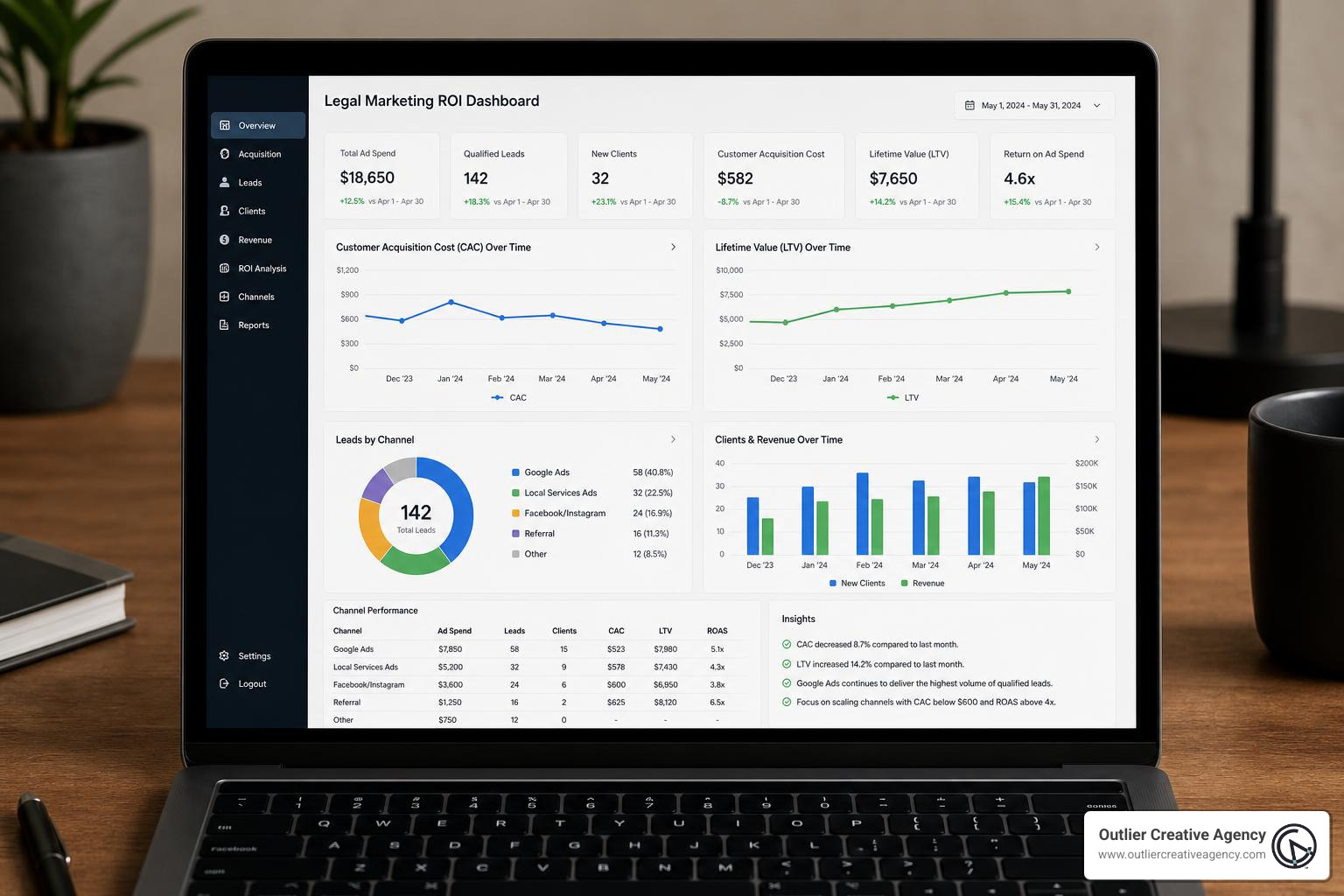
To build a highly profitable law firm, you must treat your marketing budget as an investment portfolio that requires constant tracking and rebalancing. For a deeper look at utilizing data to fuel your firm's expansion, explore Unlocking Law Firm Growth with Data Driven Strategies.
Budgeting and Resource Allocation for Digital Marketing for Attorneys
A surprising 43% of law firms do not have an annual marketing budget. Without a dedicated budget, firms often find themselves with unpredictable calendars — busy with cases one month and struggling to find clients the next.
As a general rule of thumb:
- Established Firms: Typically allocate 2% to 5% of their gross revenue to marketing to maintain their market share.
- High-Growth / Competitive Firms: Firms seeking aggressive growth or operating in highly competitive markets (like family law or personal injury in Los Angeles or Austin) commonly invest 7% to 12% of their gross revenue into digital marketing.
Agency vs. In-House
For solo practitioners and small-to-mid-sized firms, hiring a specialized agency is almost always more cost-effective than building an in-house team. To replicate the capabilities of a full-service agency in-house, you would need to hire a full-time SEO specialist, a PPC manager, a web designer, a videographer, and a copywriter. Partnering with an agency gives you immediate access to a complete team of specialists at a fraction of the overhead cost.
Tracking KPIs and ROI Metrics
To accurately measure the return on your digital marketing spend, you must track key performance indicators (KPIs) beyond simple website traffic. Focus on these critical metrics:
- Cost Per Acquisition (CPA): How much does it cost in ad spend or marketing fees to sign one new client?
- Lead Source Tracking: Utilize dynamic number insertion (DNI) and CRM integrations to track every single phone call, form submission, and live chat back to its exact source (e.g., Google LSA, organic search, or a specific blog post).
- Revenue-to-Cost Ratio: A healthy, sustainable marketing program should aim for a 5:1 revenue-to-cost ratio, meaning your average client acquisition cost should not exceed one-fifth of the average case value.
Frequently Asked Questions about Legal Marketing
How long does digital marketing take to work for law firms?
Paid advertising campaigns, like Google Ads and Local Services Ads, can start generating qualified phone calls and leads almost immediately after launching. Organic strategies, such as SEO, content marketing, and local Map Pack optimization, typically require 3 to 6 months of consistent effort to show measurable increases in organic traffic, and 6 to 12 months to deliver a steady, high-volume flow of signed cases.
What is a good ROI for attorney internet marketing?
While a 5:1 revenue-to-cost ratio (500% ROI) is the standard benchmark for a successful legal marketing campaign, mature SEO programs can frequently achieve returns of up to 1000% over a 24-month period as the compounding value of organic search equity lowers the overall cost per lead.
How do legal ethics and bar association rules impact digital marketing?
Attorneys must adhere strictly to their state's bar association rules regarding advertising. Common regulations include prohibitions on making false or misleading claims, promising specific outcomes, using the word "specialist" or "expert" unless certified by the state bar, and failing to maintain proper record-keeping of advertisements. At Outlier Creative Agency, we design all of our campaigns with a strict focus on compliance to protect your firm’s reputation and license.
Conclusion
Digital marketing is no longer just an optional support tool for your law practice — it is the primary engine for sustainable growth. In highly competitive markets like Los Angeles and Austin, waiting for referrals is a recipe for stagnation. By building a high-converting website, dominating local search results, and running highly targeted ad campaigns, you can build a predictable pipeline of high-value cases.
At Outlier Creative Agency, we are passionate about helping law firms break through the digital noise. As a premier, award-winning agency, we specialize in building custom, data-driven marketing strategies that respect legal compliance while delivering measurable growth.
Ready to stop guessing and start scaling? Book a consultation with Outlier Creative Agency today, and let's discuss how we can help you dominate your local market.