
California Attorney Marketing That Builds Cases Without Creating Compliance Risk
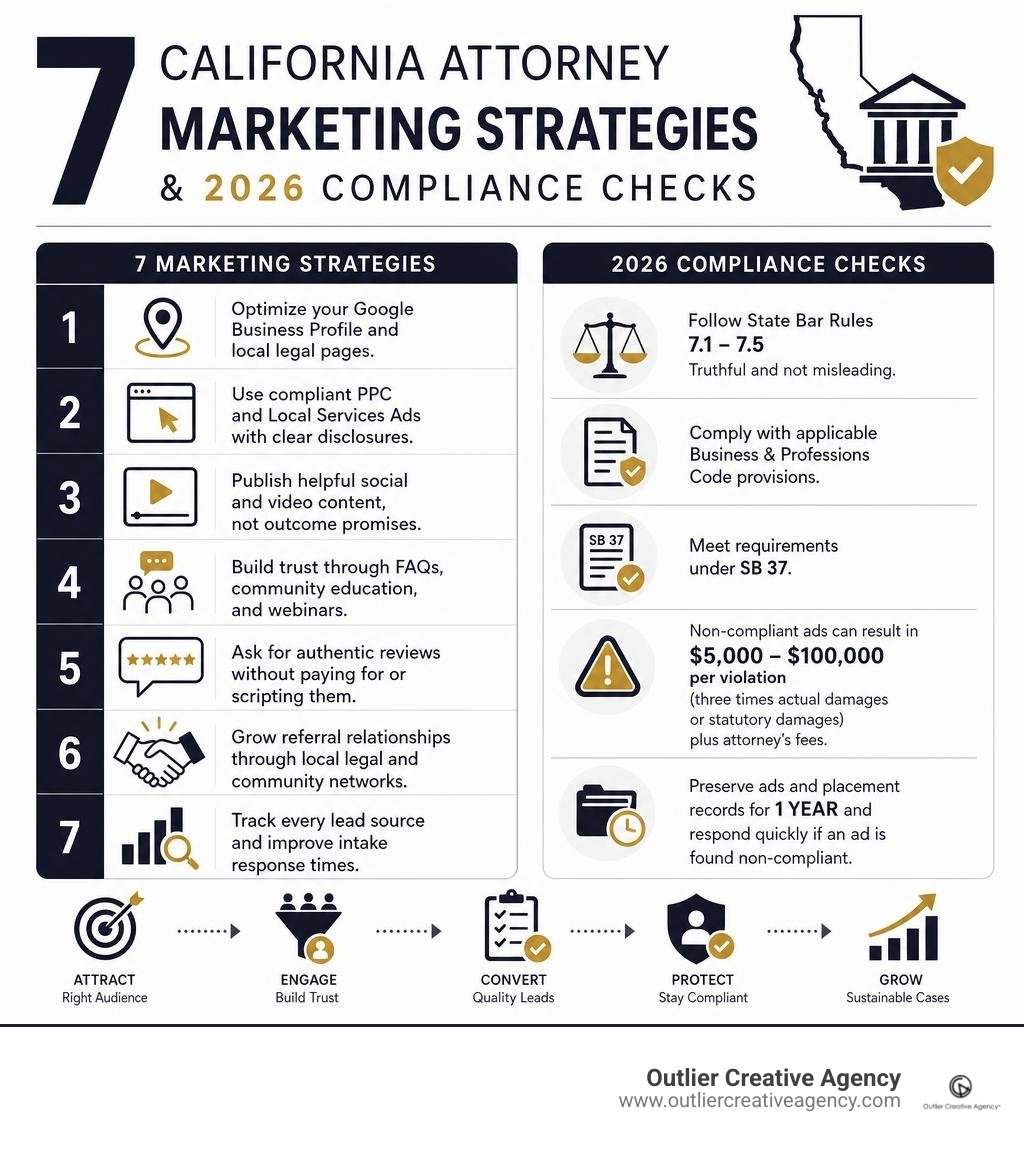
Effective California Attorney Marketing combines local visibility, useful legal education, targeted ads, reputation building, and fast intake with strict advertising compliance. Start with these seven priorities:
- Optimize your Google Business Profile and local legal pages.
- Use compliant PPC and Local Services Ads with clear landing-page disclosures.
- Publish helpful social and video content, not outcome promises.
- Build trust through FAQs, community education, and webinars.
- Ask for authentic reviews without paying for or scripting them.
- Grow referral relationships through local legal and community networks.
- Track every lead source and improve intake response times.
In 2026, compliance is not a footer-level task. California attorneys must satisfy State Bar Rules 7.1 through 7.5, applicable Business and Professions Code provisions, and SB 37. A consumer harmed by a non-compliant ad may seek the lesser of three times actual damages or statutory damages between $5,000 and $100,000 per violation, plus attorney's fees. Firms also need a system to preserve ads and placement records for one year and respond quickly if an ad is found non-compliant.
The opportunity is simple: clear, educational marketing can make a firm more visible and more credible at the same time. This guide explains how to build a practical growth system without using misleading claims, unsupported specialist labels, or guaranteed results.
I’m Corey Larson, and I work with legal professionals through Outlier Creative Agency to create websites, video, social content, and brand assets that help firms stand out. My experience with California Attorney Marketing centers on turning complex legal services into clear, credible messages that support compliant lead generation.
Understanding the 3 Regulatory Layers of California Attorney Marketing
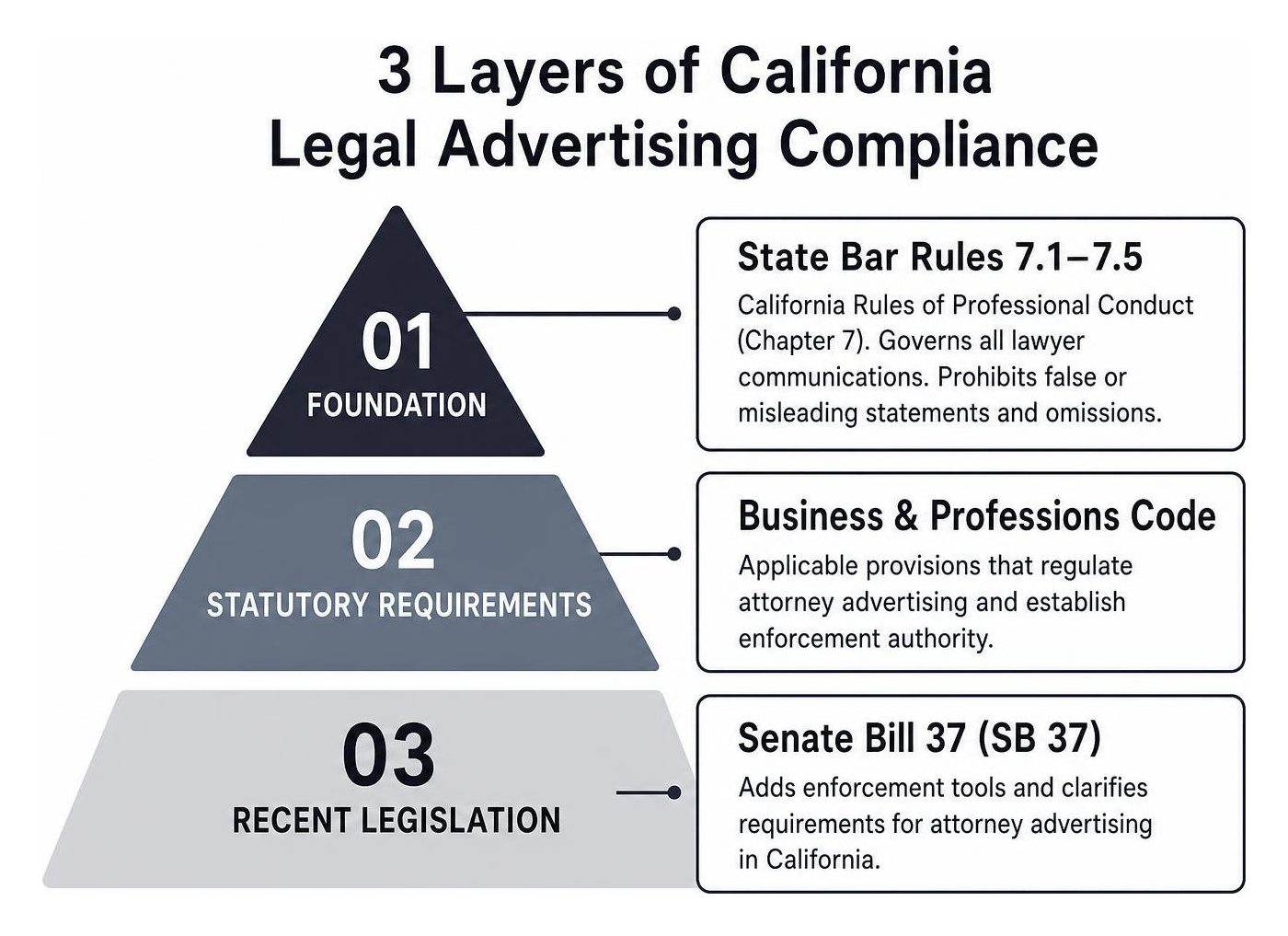
Navigating legal advertising in California requires understanding that compliance is not governed by a single rulebook. Instead, every piece of marketing material—from an organic social media post to a multimillion-dollar television campaign—operates beneath a three-tiered regulatory hierarchy. When we audit campaigns at Outlier Creative Agency (OCA), we evaluate client assets across all three layers to ensure zero exposure.
State Bar Rules 7.1 to 7.5 and California Business & Professions Code
The foundation of California legal advertising ethics rests on Chapter 7 of the California Rules of Professional Conduct (CRPC):
- Rule 7.1 (Communications Concerning a Lawyer's Services): Strictly prohibits any false or misleading communication. This includes creating unjustified expectations, omitting material facts, or making unverifiable comparisons.
- Rule 7.2 (Advertising): Authorizes public advertising through written, recorded, or electronic media, provided the name of at least one lawyer or the law firm responsible for its content is clearly disclosed. It also tightly regulates paying for referrals or recommendations.
- Rule 7.3 (Solicitation of Clients): Prohibits in-person, live telephone, or real-time electronic contact when a significant motive is pecuniary gain, unless the recipient is another lawyer or has a prior familial, personal, or professional relationship.
- Rule 7.4 (Communication of Fields of Practice and Specialization): Bans claiming to be a "certified specialist" unless officially certified by the California State Bar Board of Legal Specialization or an accredited entity.
- Rule 7.5 (Firm Names and Trade Names): Governs firm names, trade names, and domain names, barring anything misleading regarding the firm's structure, size, or identity.
Intersecting with the CRPC is the statutory layer: California Business and Professions Code §§ 6150–6159.2. These statutes regulate legal advertising formats, fee disclosures, and prohibit deceptive dramatizations. Furthermore, state consumer protection statutes—such as B&P Code § 17200 (Unfair Competition Law) and B&P Code § 17500 (False Advertising Law)—allow regulatory bodies to enforce civil penalties against deceptive marketing practices.
Senate Bill 37 Compliance and the $100K Private Right of Action
The enforcement landscape shifted dramatically with the enactment of Senate Bill 37 (SB 37). Before this legislation, advertising violations were primarily handled through State Bar disciplinary proceedings. SB 37 introduced a major financial risk: a statutory private right of action empowering consumers misled by non-compliant ads to file civil lawsuits.
Under SB 37, plaintiffs can recover:
- The lesser of three times actual damages or statutory damages ranging from $5,000 to $100,000 per violation.
- Mandatory attorney's fees and litigation costs.
The law also broadens the definition of an legal advertisement to explicitly include landing pages, lead-generation funnels, paid directory listings, and automated marketing messages. If a firm partners with a third-party lead generation provider that runs non-compliant ads, the law firm itself can be held jointly liable under SB 37.
| Regulatory Dimension | State Bar Disciplinary Process | SB 37 Civil Exposure |
|---|---|---|
| Primary Initiator | State Bar Intake / Competing Lawyers | Misled Consumers / Class Action Plaintiffs |
| Primary Penalty | Reprimand, Suspension, Disbarment | $5,000–$100,000 Statutory Damages + Treble Damages |
| Financial Exposure | Administrative Fines, Bar Defense Costs | Crippling Civil Judgments + Plaintiff Legal Fees |
| Remediation Window | Formal Bar Response Deadlines | Strict 72-Hour Digital Takedown Requirement |
What Are the Non-Negotiable Ethics Rules for California Legal Ads?
Ethical compliance is your firm’s most valuable brand asset. Far from stifling creativity, mastering the rules allows firms to craft confident, authoritative marketing that outperforms generic competitor campaigns.

Mandatory Disclosures, Specialty Claims, and Testimonial Guidelines
To pass an ethical audit, legal advertisements must include specific disclosures:
- Responsible Attorney Identification: Every advertisement, website, landing page, and video must state the name and bona-fide office address of at least one attorney responsible for its content.
- Specialization Standards: While an attorney may state that their practice is "focused on" or "limited to" personal injury or family law, they cannot claim to be a "specialist," "certified specialist," or "expert" unless certified by the State Bar of California Board of Legal Specialization or an accredited entity, with the certifying body clearly named.
- Client Testimonials and Endorsements: Under Rule 7.1 and statutory standards, testimonials must reflect genuine client experiences. They require written client consent, and if monetary compensation was provided, that fact must be conspicuously disclosed.
- Past Case Results & Financial Recoveries: Any mention of past settlements or verdicts must include clear, conspicuous disclaimers explaining that past results do not guarantee, warrant, or predict future outcomes. Where net sums are referenced, disclosures must specify whether client costs and fees were deducted.
- Actor Dramatizations: If an ad uses professional actors or reenactments, it must include an explicit disclosure stating "DRAMATIZATION" or "ACTOR PORTRAYAL."
For businesses seeking outside compliance reviews, working with specialized Los Angeles Advertising & Marketing Lawyers provides an added layer of operational safety.
Record Retention Rules and the 72-Hour Ad Takedown Requirement
Under California Business and Professions Code § 6159.1, attorneys must maintain a true and correct copy of every written, recorded, or electronic advertisement for at least one year following its last date of dissemination.
Important Compliance Note: While historical regulations (such as former Rule 1-400) required a two-year retention period, modern practice under § 6159.1 establishes a strict one-year requirement. Your archive must include records showing exactly when and where the advertisement ran.
Additionally, under SB 37 enforcement protocols:
- Electronic Advertisements: Once a State Bar determination or formal non-compliance notice is issued, digital ads, landing pages, and social campaigns must be taken down within 72 hours.
- Broadcast & Print Media: Notice must be provided to publishers within 72 hours, with complete campaign withdrawal finalized within 30 days.
7 Proven Strategies to Scale Your Law Practice
Building a high-growth law practice in California requires an integrated strategy that pairs technical performance with rigorous ethical standards.
1. Local Search Optimization in California Attorney Marketing
Local search visibility drives consistent caseload growth. In major metro areas like Los Angeles, San Diego, and the San Francisco Bay Area, organic search competition is fierce. Winning requires technical precision, hyper-local content architecture, and clean citation profiles.
Begin by optimizing your Google Business Profile (GBP). Your primary practice category must reflect your core focus (e.g., "Personal Injury Attorney" or "Family Law Attorney"). Ensure your Name, Address, and Phone Number (NAP) match your official State Bar profile.
Next, develop localized content silos that address jurisdictional legal questions. Rather than publishing generic articles on car accidents, create resources discussing local court procedures, regional traffic corridors, and local ordinances.
- To dominate Southern California personal injury search results, read our deep-dive on California Personal Injury SEO.
- For firms targeting the Los Angeles basin, discover local optimization tactics in our guide to Los Angeles SEO for Lawyers.
2. Hyper-Targeted PPC Campaigns and Local Services Ads
Pay-Per-Click (PPC) advertising provides immediate visibility, but without careful management, ad budgets can disappear rapidly. In California legal markets, high-intent keywords can exceed $200 per click.
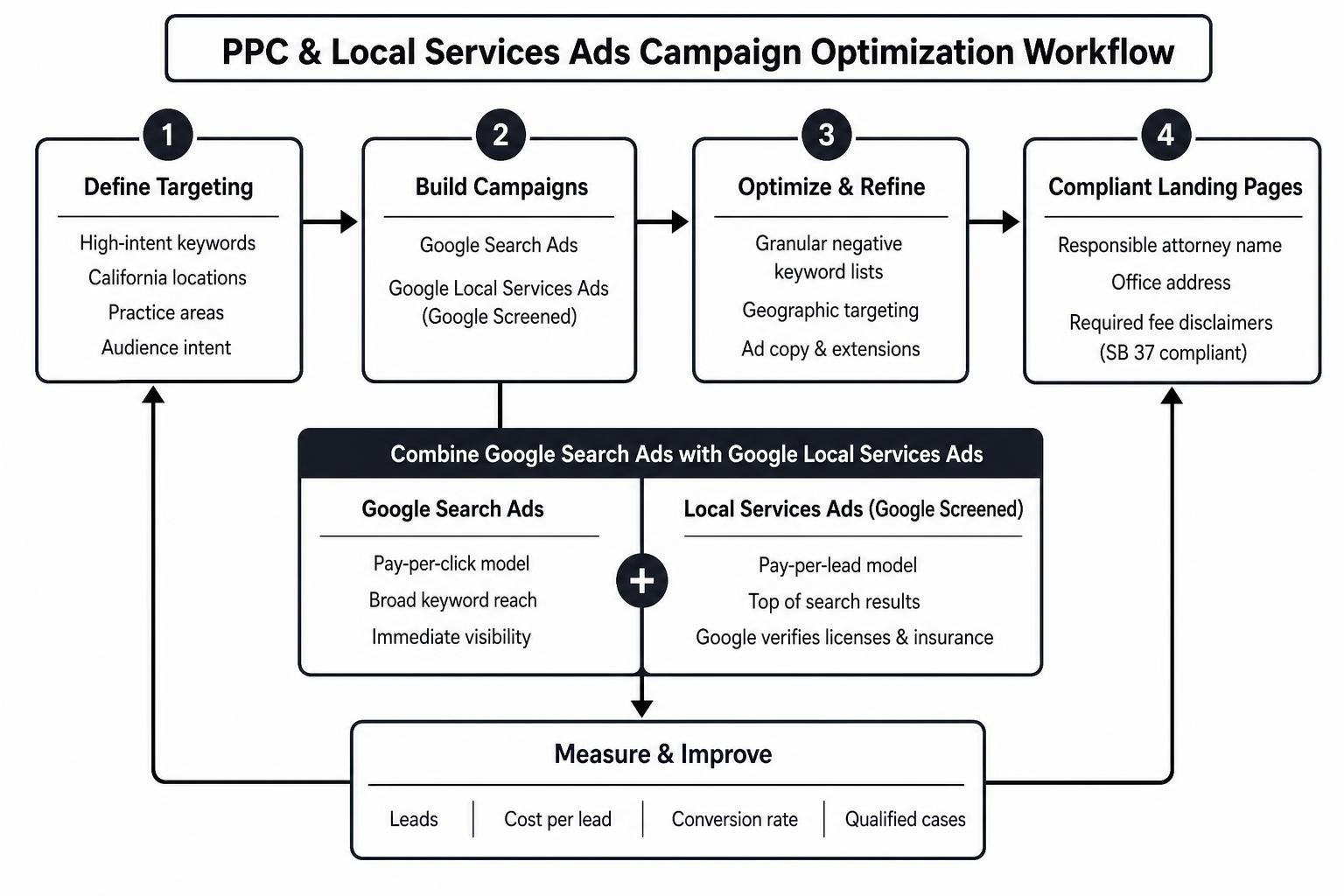
Combine Google Search Ads with Google Local Services Ads (LSAs):
- Local Services Ads (Google Screened): LSAs operate on a pay-per-lead model rather than pay-per-click, positioning your firm at the very top of Google's search results. Because Google verifies State Bar licenses and insurance, these placements carry high trust.
- Granular Negative Keyword Lists: Eliminate wasted spend by filtering out terms like "pro bono," "free legal aid," "jobs," and "forms."
- Compliant Landing Pages: Every landing page linked from a paid ad must display your responsible attorney name, office address, and required fee disclaimers to satisfy SB 37.
Explore market-specific paid acquisition strategies:
- Master the fundamentals using our complete PPC Marketing Guide for Lawyers.
- Review our dedicated campaign blueprints for San Diego Personal Injury Ads and San Diego Divorce Attorney Ads.
3. Compliant Social Media and Video Strategies for California Attorney Marketing
Video and organic social media content provide powerful channels for building authentic connections with potential clients. Platforms like LinkedIn, YouTube, and Meta allow attorneys to demonstrate subject-matter authority before a consultation even occurs.

To maintain compliance when producing video and social content:
- Add On-Screen Disclaimers: Include a clear lower-third or opening/closing screen stating: "This video is for educational purposes only and does not constitute legal advice. No attorney-client relationship is formed."
- Avoid Direct Solicitation: Under Rule 7.3, never send direct, unprompted direct messages (DMs) to individuals who have experienced an accident or legal incident. Focus on publishing public, educational content.
- Use Balanced Language: Avoid clickbait titles like "How I Guaranteed a $1M Win" or claims calling yourself the "#1 Best Trial Attorney." Instead, use educational framing such as "Understanding California Comparative Fault Rules."
To build a compliant multi-platform social media strategy, review our guide to Attorney Social Media Marketing California.
4. Ethical Content Marketing and Educational Community Outreach
Educational marketing builds authority while naturally adhering to California's strict advertising rules. By shifting from promotional slogans to educational resources, your firm becomes a trusted community guide.
- Comprehensive FAQ Hubs: Answer real questions clients ask during intake. For example, explain California's two-year personal injury statute of limitations or how community property is divided under the Family Code.
- Community Webinars & Public Seminars: Host virtual workshops for local community groups, property owners, or entrepreneurs.
- Sponsorships & Bar Associations: Partner with organizations like the California Lawyers Association (CLA) to sponsor events and build industry leadership.
To expand your digital footprint ethically, explore our guides on Digital Marketing for Attorneys and Internet Marketing for Attorneys.
If you are expanding your firm's internal marketing team, monitoring listings for Consulting Legal Marketing jobs in Austin, Texas ... can help identify industry compensation benchmarks and skill requirements.
5. Reputation Management and Ethical Review Acquisition Systems
Social proof plays a pivotal role in legal consumer decision-making. However, gathering client reviews requires strict adherence to State Bar regulations and platform terms of service.
- Automated Review Requests: Implement post-resolution workflows that send automated email or SMS requests inviting clients to leave feedback on Google or Yelp.
- Never Incentivize Reviews: Offering gift cards, discounts, or fee credits in exchange for reviews violates both State Bar rules and FTC regulations.
- Responding to Negative Reviews Compliantly: If a disgruntled client leaves a negative review, never disclose confidential case facts or confirm representation without client consent. A professional response should state: "Thank you for your feedback. We take all client experiences seriously. Please contact our managing partner directly so we can address your concerns."
Learn how to build sustainable marketing systems in our guide on How to Market Law Firm.
6. Strategic Legal Networking and Bar Association Partnerships
A significant portion of premium legal work originates through peer referrals. Building relationships with attorneys in complementary practice areas ensures a steady influx of high-quality cases.
- Reciprocal Referral Networks: Estate planning attorneys frequently refer contested probate matters to litigators; corporate lawyers refer employment disputes.
- Co-Counsel Arrangements (Rule 1.5.1): California permits referral fees between attorneys outside the same firm, provided the client gives informed written consent after full disclosure of the fee-sharing agreement and the total fee is not unconscionable.
- Legal Directories: Claim and maintain accurate profiles on Avvo, Justia, FindLaw, and Martindale-Hubbell, ensuring all listed addresses and contact details align with your State Bar records.
Discover how integrated practice strategies drive growth in our overview of Law Firms Digital Marketing.
7. Conversion Rate Optimization and Automated Intake Workflows
Generating inbound traffic is only half the battle. If your law firm takes hours to respond to an inquiry, your acquisition spend goes to waste.
Data shows that legal leads contacted within 5 minutes are significantly more likely to retain compared to those contacted after 30 minutes.
- 24/7 Compliant Live Chat: Integrate 24/7 web chat staffed by trained operators who qualify leads and book initial consultations without dispensing legal advice.
- Streamlined Intake Forms: Keep web forms brief—asking for name, contact details, and a brief description of the legal matter.
- CRM Integration: Automatically route incoming leads into legal practice management platforms (such as Clio, Filevine, or Lead Docket) to trigger instant confirmation messages.
Frequently Asked Questions About California Attorney Marketing
How did SB 37 change legal advertising liability in California?
SB 37 established a private right of action permitting consumers to file civil lawsuits against law firms running false or non-compliant advertisements. Plaintiffs can recover the lesser of three times actual damages or statutory damages between $5,000 and $100,000 per violation, plus mandatory attorney's fees. It also broadened the statutory definition of an advertisement to encompass digital landing pages, lead funnels, and AI-generated marketing content.
How long must law firms retain copies of their advertisements?
Under California Business and Professions Code § 6159.1, attorneys must retain a true and correct copy of all written, recorded, or electronic advertisements for one year following their last dissemination. The record must document the specific dates and media channels in which the advertisement appeared.
Can a California lawyer claim specialist status in marketing materials?
No, unless the attorney is officially certified as a legal specialist by the California State Bar Board of Legal Specialization or an accredited certifying entity. The ad must also explicitly name the certifying organization. Attorneys who are not certified may state that their practice is "limited to" or "focused on" specific fields of law.
What disclosures are required when advertising past case results?
When highlighting past case results, settlements, or verdicts, California rules require clear and conspicuous disclaimers explaining that past performance does not guarantee or predict future outcomes. If an advertisement references gross recovery amounts, it must clearly disclose whether client-borne litigation costs, expenses, and attorney fees were deducted.
Conclusion
Scaling a law practice in California does not require walking an ethical tightrope. By building a marketing infrastructure rooted in local search optimization, compliant paid campaigns, authentic educational media, and modern client intake, your firm can establish a sustainable competitive advantage.
At Outlier Creative Agency, we build data-driven marketing systems designed exclusively for law firms. From high-converting digital creative to multi-channel search campaigns, our award-winning team helps legal practices scale responsibly and profitably.
To build a high-performing paid campaign tailored to your practice area, explore our specialized solutions for PPC advertising for law firms today.